Plant care · 14 min read
Fungus gnats: what they tell you about your watering
Fungus gnats breed in compost that stays wet, which is why they turn up in heating season. What their life cycle says about your watering, how to break it without spraying, and how to tell when a pot is still too wet to water.
Botanical Legacy · Field notes ·
A fungus gnat is not a pest problem. It is a soil-moisture reading with wings.
The gnat is the messenger, the compost is the problem
The small dark flies that lift off a pot when you water it are fungus gnats, also called sciarid flies. The RHS describes the adults as dark greyish-brown flies, mostly 3 to 4mm long, that run over the compost or fly slowly around the plant. They are weak fliers, they do not bite, and the adults do no damage to plants. UC IPM, the University of California's pest management programme, and the RHS agree on all three points. If the flies were the whole story, they would be a nuisance and nothing more. To be sure that is what you have, look at the antennae: UC IPM notes a fungus gnat's are longer than its head, while the similar shore fly has short, bristle-like ones. The common houseplant pests guide covers the other usual suspects.
The story is underneath. Females lay their eggs in the surface layer of moist potting compost, and the larvae live there: slender, translucent, legless maggots with shiny black heads, up to about 6mm long. Colorado State University Extension finds them usually in the top 5 to 8cm of the mix, depending on how moist it is. They feed mainly on fungi, algae and decaying organic matter, which is exactly what grows in compost that never dries out. The RHS puts it simply: they thrive in damp compost with high organic matter.
That is why a gnat problem is very often a watering problem, the same pattern overwatering versus underwatering walks through from the leaf side. A pot that dries between waterings is a poor nursery. A pot that stays wet for weeks is an ideal one, and the flies you see are the adults that came out of it.
The numbers explain how fast it gets out of hand. According to Colorado State, a female lives seven to ten days and can lay up to 200 eggs. At typical room temperatures of about 18 to 24°C, the whole cycle from egg to adult takes three to four weeks; UC IPM gives about 17 days at 24°C, and warmer is faster. Wisconsin Horticulture adds that indoors the stages overlap, so eggs, larvae, pupae and adults are all in the pot at once. Swatting adults removes a few hundred potential eggs. The pot keeps producing more for as long as it stays wet.
Why they turn up in heating season
Colorado State notes that fungus gnat problems tend to be most noticeable in late autumn and winter, and gives two reasons. Plants kept outdoors over summer are often colonised there, and the population builds once they come inside, which is one more reason to check plants before bringing them in. And people keep watering through autumn and winter at the rate they used in summer, which keeps the compost moist.
Winter is when plants need the least. The RHS points out that in cool rooms, houseplants can be left a week or two without water, and that low winter light limits what the plant can use. Shorter days and lower light slow the plant's water use, so the same watering habit that suited July leaves the compost wet in November. Central heating complicates it: it dries the air, and the RHS notes pots can dry faster in dry air. Which effect wins depends on the room, the plant and the pot, and that is the point. A fixed schedule cannot know which room it is in, which is the whole case for watering on signals rather than dates.
Colorado State adds two more quiet causes: adults are drawn to mixes high in peat, and old, broken-down compost holds more water than fresh. A plant that has sat in the same pot for years is easier to overwater than it was when it was potted.
What to do
Let the top of the compost dry before you water again. Wisconsin Horticulture calls reducing moisture the single most important step, and suggests letting the top 2 to 3cm dry before watering; Colorado State says to dry especially the top 2.5 to 5cm, which kills eggs and larvae and makes the surface less attractive for laying. Push a finger in. If it comes out damp, wait, whatever the calendar says. Lifting the pot works too: the RHS notes that drier pots feel lighter than wet ones.
Water from the bottom for a few weeks. Standing the pot in a tray of water and letting it draw up from below wets the root ball while the top layer, where eggs are laid, stays drier. Wisconsin lists bottom watering as an alternative to top watering for exactly this reason. Pour off whatever is left in the tray afterwards. The RHS advises emptying saucers so the plant never sits in water.
Add a layer of coarse sand or fine gravel. Wisconsin suggests a 1 to 2.5cm layer of coarse sand or fine gravel over the compost. It dries fast, so the surface stops being a nursery, and it makes the compost harder for females to reach.
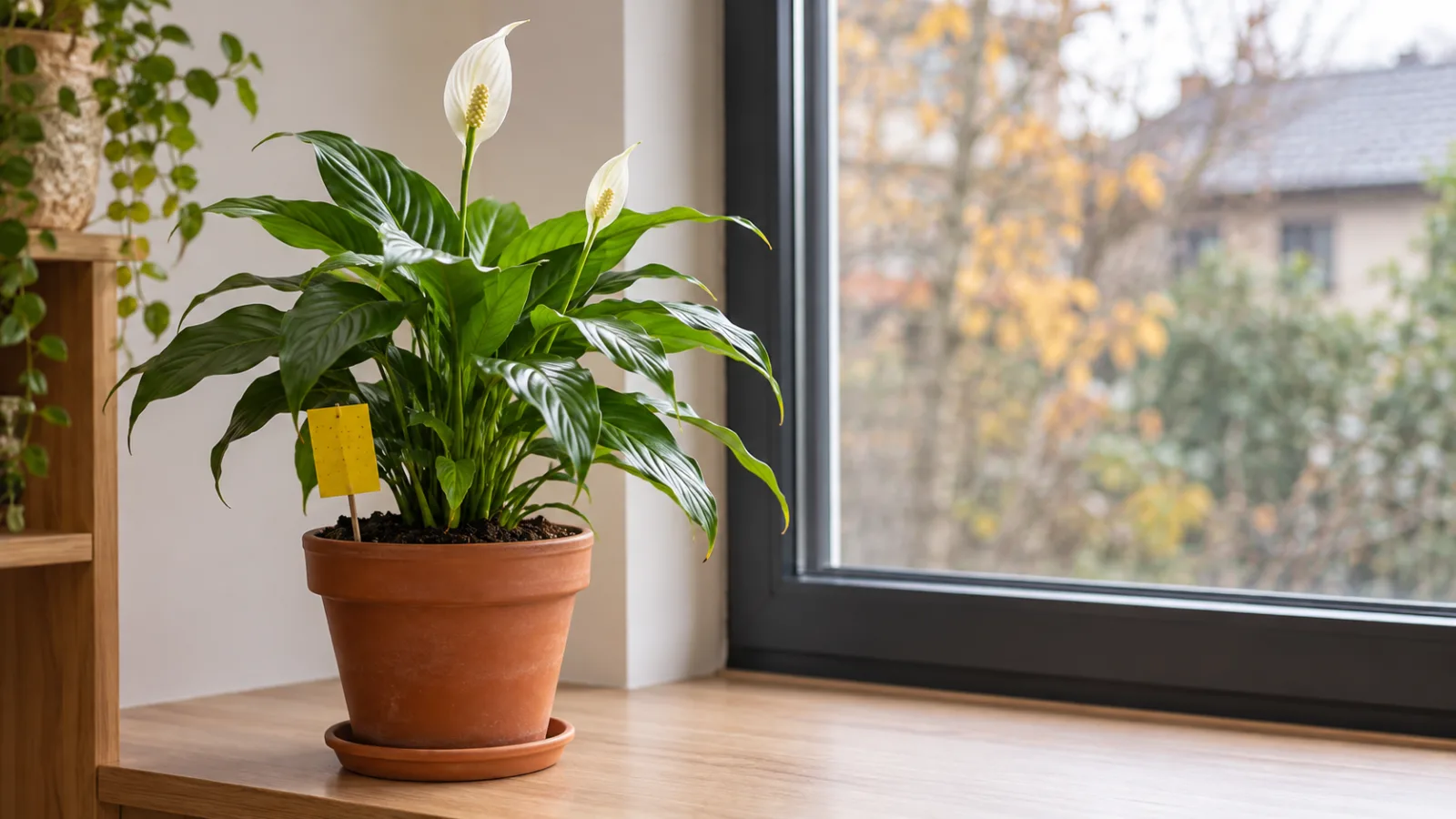
Use yellow sticky traps to count, not to cure. Yellow sticky cards laid near the compost catch adults, and UC IPM and Colorado State both recommend them. They tell you whether numbers are rising or falling, and they take some egg-laying females out. They do nothing to the larvae already in the pot, and the RHS warns they catch many other small creatures too, including predators. Put them close to the pot rather than across a room.
Check for larvae with a slice of potato. Wisconsin's method: lay a slice of raw potato on the compost and look underneath after three or four days. Larvae migrate to it to feed. No larvae on the potato and falling numbers on the trap means the cycle is breaking.
Treat the larvae, not the air. If drying is not enough, the targeted treatments act in the compost. Bacillus thuringiensis israelensis (Bti), sold for this as a soil drench and in mosquito-control granules, kills fly larvae only. Wisconsin notes it does not touch eggs, pupae or adults, so it needs repeating; UC IPM says indoors that can mean applications about five days apart. The nematode Steinernema feltiae, watered into the compost, is particularly effective against the larvae according to Colorado State, and works best between about 15 and 32°C with moist conditions, per UC IPM. Spraying the air is useless: Wisconsin calls it ineffective, and UC IPM says insecticides are rarely warranted for gnats in the home at all.
Repot a badly infested plant into fresh compost. The RHS suggests repotting into new compost and throwing out the old, which removes the population and the waterlogged, broken-down mix in one go. Use a pot only slightly larger than the root ball, because a big pot holds more water than the roots can use.
Keep going for a full life cycle. Because eggs, larvae and pupae overlap, a week of drier compost does not finish the job. Wisconsin's guidance for plants brought in from outdoors is three to four weeks of changed watering and a sand or gravel layer. That is roughly one complete generation: long enough for the larvae already in the pot to run out of time.
Three ways this plays out
The peace lily on the weekly schedule
A peace lily has been watered every Sunday since spring, when it drank a full jug a week in a bright window. In November the window gives a fraction of the light, and the compost is still damp the following Sunday, and the one after. Gnats appear in the second week of the month. Nothing about the plant changed. Its need for water fell, and the schedule did not. Moving to "water when the top few centimetres are dry" stretched the interval to well over a week, and the gnats were gone within a month. The lesson: the gnats arrived on the day the schedule stopped matching the plant.
The tray of pothos cuttings
A tray of pothos cuttings, kept wet on purpose because cuttings need moisture to root, filled with gnats within a fortnight. This is the one case where the larvae can do real damage: the RHS notes some species feed on seedling roots and the base of soft cuttings, while established plants are unlikely to be harmed. The answer was not to let the cuttings dry out. It was to keep the compost just moist rather than soggy, add a thin grit layer, and water the tray from below. The lesson: where a plant needs damp compost, change the surface, not the moisture.
The jade plant that never had gnats
A jade plant on the same windowsill as the infested peace lily never had a single gnat in it. It shares the room, the air and the flies. What it does not share is wet compost: a gritty mix, watered rarely, dry almost all the way down between drinks. The adult gnats visited, found nowhere to lay, and left. The lesson: gnats spread between pots, but they only settle where the compost lets them.
What Botanical Legacy does about it
Gnats come from one question asked badly: is this pot still wet? A schedule answers it from the calendar. Botanical Legacy tries to answer it from the pot, with a dry-down forecast kept separately for every Specimen.
Every Specimen shows how wet its compost is now, as a model. On the free plan as well as the paid one, a Specimen's page and its card in your Sanctuary show a modelled soil moisture between 0 and 100%, with a word beside it: Well watered above 70%, then Normal, Dry, and Critically dry below 20%. The number is projected from the last watering you logged, at that Specimen's own drying rate, so it falls a little every day between waterings. A pot that reads Well watered for days is the pot the gnats are looking for.
The watering date is the day the model says the pot will be dry. Each Specimen's Digital Shadow is recalculated every night and again after you log care, and its next watering date is the day its modelled moisture is projected to fall to 20%. Logging a watering resets the model to full and starts the dry-down again. So in November, when the compost dries more slowly, the date moves out on its own rather than arriving every Sunday.
The drying rate is built from the plant, the pot and the room. The rate starts from the species' usual watering interval and is adjusted for temperature and humidity, the soil type you chose (a fast-draining mix dries faster than a moisture-retaining one), the size of the pot, the light, and, if you turn on seasonal care, the plant's dormant season. It is kept within limits tied to the species' usual interval, so one odd input cannot run away with it. Which numbers it uses depends on what it can see: on the paid plan, a soil-moisture sensor connected through Home Assistant replaces the model with the measured dry-down of that pot, and a room sensor or local weather (switched on in Preferences) supplies the temperature and humidity. With neither, an indoor Specimen runs on an assumed 21°C and 50%.
Reminders come from the forecast, not a fixed interval. When the date arrives, the app lists the Specimen as needing water that day, and a morning summary notification says how many plants need attention. A pot that is still wet simply is not due yet.
On the paid plan, you can ask what happens if you hold off. The Shadow tab's what-if simulator re-projects a Specimen 7, 14 or 30 days ahead with or without a watering, and shows where its soil moisture is now and where it is projected to be at the end. For a gnat-infested pot, that is the question: how long until the top of this compost is genuinely dry, if I wait?
The Doctor can name gnats, but a trap sees them first. When you send the Doctor a photo (powered by Botanical Vision v5, one photo read), its pest check lists fungus gnats among the pests it can name, alongside mealybugs, spider mites, scale, thrips, aphids and whiteflies. It runs that check only when the photo shows a plant that is not healthy, and a 3mm fly on the compost is easy for any photo to miss. For gnats, the yellow card is the better detector.
What the model can't see
The model holds one number for the whole pot. Gnats care about the top few centimetres, which dry first, and the model does not separate the surface from the root ball. A pot it reads as Normal can still have a damp surface after a top-watering, and a pot you have been bottom-watering may have a drier top than the number suggests. Your finger in the compost is still the check for the surface.
It also cannot see the gnats. Nothing in the forecast knows there are flies in the room, and there is no pest log to tell it, so a gnat outbreak changes nothing in the Specimen's numbers. What it can tell you is whether the pot has had time to dry: if gnats keep coming back to a Specimen that is always Well watered or Normal when you water it, the forecast and the flies are telling you the same thing.
And it only knows what you log. A watering you forget to record leaves the model thinking the pot is drier than it is, and a sensorless Specimen with no local weather runs on an assumed room, which in a cold flat in November can be warmer than the truth, and a warmer room dries compost faster in the model than in your pot. If the date says water and your finger says damp, believe your finger and wait.
Frequently asked questions
What causes fungus gnats in houseplants?
Compost that stays moist. Fungus gnats lay their eggs in the surface of damp potting compost, and their larvae feed on the fungi, algae and decaying organic matter that grow there. Overwatering, poor drainage, a saucer left full of water and old compost that holds water all make a pot more attractive. Adults also come in on plants that spent the summer outdoors, but they only build a population where the compost lets them breed.
Are fungus gnats a sign of overwatering?
Very often, yes. A lasting population means the top layer of compost is staying wet long enough for eggs to hatch and larvae to grow, which takes three to four weeks at room temperature. A few flies that drifted in from another plant say little. Flies that keep coming back to the same pot week after week say the compost is not drying between waterings.
How do I get rid of fungus gnats for good?
Break the life cycle at the compost. Let the top 2 to 5cm dry between waterings, water from the bottom for a few weeks, add a 1 to 2.5cm layer of coarse sand or fine gravel, and use yellow sticky traps to watch the numbers fall. If drying alone is not enough, treat the larvae with Bti or the nematode Steinernema feltiae. Keep it up for three to four weeks, one full generation, before deciding it has worked.
Do fungus gnats harm plants or people?
The adults do not bite people and do not damage plants. The larvae feed mostly on fungi and decaying matter, and established plants are unlikely to be harmed. The exception is very young growth: in large numbers, larvae can feed on the roots of seedlings and the base of soft cuttings, so a propagation tray deserves quicker action than a mature plant.
Why do I have fungus gnats in winter?
Because winter is when compost stays wet longest. Plants use less water in the low light of late autumn and winter, but many people keep watering at their summer rate, so the compost stays moist. Plants brought in from outdoors often carry gnats with them, and warm indoor rooms keep them breeding all year.
Do sticky traps get rid of fungus gnats?
Not on their own. Yellow sticky traps catch adults, which helps you count them and removes some egg-laying females, but the larvae in the compost carry on. Use traps alongside drier compost and, if needed, a larval treatment such as Bti.
Can Botanical Legacy tell me when my plant's compost is still too wet?
Every Specimen on the free plan shows a modelled soil moisture for its pot, with a band word (Well watered, Normal, Dry, Critically dry), and a watering date set for the day the model projects the compost to dry to 20%. It is recalculated every night and after each care log, from the species, the pot, the soil type and the room conditions. On the paid plan, a soil-moisture sensor connected through Home Assistant replaces the estimate with a measured reading. The model covers the whole pot, so for the top layer, where gnats breed, a finger in the compost is still the final check.
Start your sanctuary
Botanical Legacy's free plan covers up to five Specimens, each with its own Digital Shadow recalculated every night to forecast how fast its compost dries and set its watering date. Every new account also gets a 14-day trial of Cultivator, the paid plan, which adds local weather data, the Shadow's what-if simulator, and sensor support via Home Assistant, so a soil-moisture sensor can replace the estimate with a measurement.
Start your sanctuary - five free specimens, no payment required →
The gnats are not the problem with the pot. They are the pot telling you about the problem.
Sources
8 references
The plant-care facts on this page were checked against these references.
- RHS fungus gnats: rhs.org.uk/biodiversity/fungus-gnats
- UC IPM Pest Notes: Fungus Gnats: ipm.ucanr.edu/PMG/PESTNOTES/pn7448.html
- Colorado State Extension: extension.colostate.edu/resource/fungus-gnats-as-houseplant-and…
- Wisconsin Horticulture: hort.extension.wisc.edu/articles/fungus-gnats-on-houseplants
- RHS how to grow houseplants: rhs.org.uk/plants/types/houseplants/growing-guide
- RHS overpotting: rhs.org.uk/prevention-protection/overpotting
- RHS cuttings from houseplants: rhs.org.uk/plants/types/houseplants/how-to-take-cuttings-from-h…
- Virginia Tech SPES-804: pubs.ext.vt.edu/content/pubs_ext_vt_edu/en/SPES/spes-804.html