Species care guide
Amaryllis
Hippeastrum hybrids
How to care for an amaryllis through the whole year: light and water in flower, what to do after flowering, the cool rest that sets next year's buds, watering a bulb without rotting it, and why some bulbs make only leaves.

- Light
- A sunny window while in leaf, ideally south-facing; out of direct sun and somewhere cooler once the flowers open
- Water
- Sparingly until growth shows, then when the surface of the compost feels dry; never leave it standing in water; little or none while resting
- Humidity
- The extension guides set no humidity target; keep a plant in flower away from heaters and air vents
- Temperature
- About 21°C to start; 15–18°C in flower; a rest at about 10–13°C for 8–10 weeks before reflowering
- Pets & toxicity
- Toxic to cats, dogs and horses; the bulb is the most poisonous part
- Difficulty
- Moderately easy to flower once; flowering again takes a year of steady care
An amaryllis flowers on last summer's leaves. The bulb you buy has already done that work; the bulb you keep has to do it again.
What an amaryllis is
The bulb sold as amaryllis every autumn is a Hippeastrum. NC State Extension notes that there is also a separate genus called Amaryllis, with only two species, both native to South Africa, and University of Wisconsin–Madison Extension calls those the true amaryllis, or belladonna lilies. The bulb on your windowsill is a different plant from a different continent.
Hippeastrum is native to the tropical and subtropical Americas. Wisconsin places most of its roughly 90 species in two areas, eastern Brazil and the central southern Andes of Peru, Bolivia and Argentina, with a few reaching as far north as Mexico and the West Indies. The big bulbs sold for Christmas are hybrids: most modern commercial hybrids come from six species, and breeding began in England in 1799.
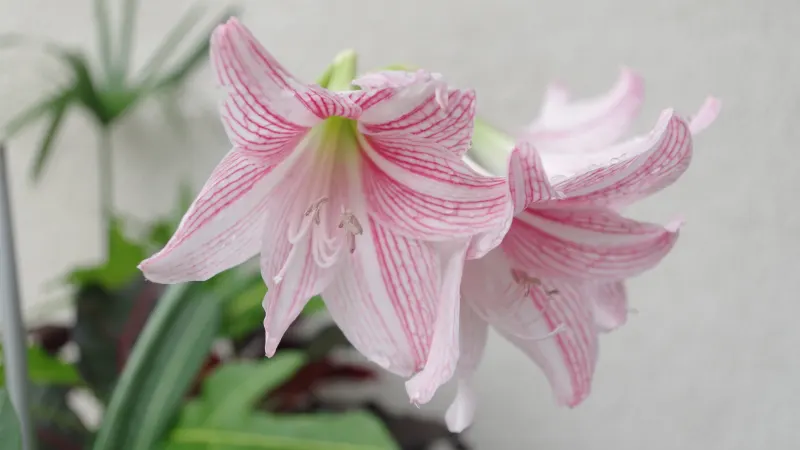
Each bulb sends up one or more hollow, leafless stalks carrying two to six trumpet-shaped flowers, and the strap-shaped leaves usually arrive around the time the flowers open. The RHS gives a height of 25–90 cm. Bulb size matters when you buy: Clemson Extension notes that bulbs are sold by circumference, and a 30–32 cm bulb generally gives two stalks with three or four flowers each.
The amaryllis year: flower, feed, rest, repeat
The flowers you see in winter were paid for by the leaves the summer before. Iowa State University Extension puts it plainly: after flowering, the bulb has to replenish the food reserves it spent, and the leaves make that food. Kept and grown on, the RHS says, it will flower year after year.
Planting to flowering. The RHS plants bulbs between October and January and expects flowers six to eight weeks later. Iowa State adds that bulbs grown in South Africa often flower three to five weeks after potting, and Dutch-grown bulbs six to eight. Start it warm, at about 21°C, in good light, and water sparingly until leaves or a stalk appear.
In flower. Once the buds show colour, move the plant somewhere cooler and out of direct sun. The RHS suggests about 15–18°C to extend the flowering period. Stake large-flowered cultivars. NC State notes that the blooms last three to four weeks, and Missouri Botanical Garden adds a small trick: removing the pollen-bearing stamens with tweezers as they develop extends the life of each flower.
After flowering. Remove each flower as it fades, so the plant does not set seed. Illinois Extension notes that making seed uses up energy and can mean fewer flowers in later years, and Wisconsin suggests taking the swollen part behind the petals along with them. The sources differ on the stalk itself. The RHS cuts spent spikes down to the base straight away, while Illinois prefers to wait until the stalk yellows, because a green stalk still photosynthesises. Either way, keep every leaf. Clemson calls keeping the plant growing after it blooms the secret of success with amaryllis.
Spring and summer: build the bulb. Give it the sunniest window you have, water when the surface of the compost is nearly dry, and feed it. The RHS uses a balanced liquid fertiliser weekly; Iowa State a balanced feed at half strength every two to four weeks. Clemson warns that feeding a bulb with no leaves can kill its roots, so feed only once it is in growth. Once there is no risk of frost, the pot can spend the summer outdoors. Harden it off in shade for a few days first, then give it more sun, shaded from scorching sunshine, as the RHS advises. Keep it in its pot: Wisconsin notes that the roots are brittle and do not take well to being planted out and dug up.
Autumn: the rest. In late September, the RHS moves the plant to a well-lit place at about 13°C for eight to ten weeks, stops feeding and reduces watering, so the bulb becomes semi-dormant with its leaves still on. Its alternative, and Iowa State's main method, is a full rest: withhold water, cut the leaves off once they are brown, and keep the bulb in its pot somewhere cool, where light is not needed. The RHS gives one to two months; Iowa State 10–13°C for at least 8–10 weeks.
Is the rest essential? The sources do not quite agree. Iowa State says the bulbs must have 8–10 weeks at 10–13°C to flower, and Missouri Botanical Garden asks for at least two months of dormancy, while Wisconsin and Illinois say a rest is not needed but lets you control when they flower. A cool rest, dry or in leaf, meets every source's condition.
Waking it up. After the rest, the RHS cuts any remaining old leaves to 10 cm from the neck of the bulb, replaces the top 2.5–5 cm of compost, and treats it like a newly planted bulb: warm, bright, and watered sparingly until it grows. Illinois and Wisconsin both expect flowers four to six weeks after a rest.
Light: sun for the leaves, shade for the flowers
A growing amaryllis wants sun. Clemson recommends at least four hours of direct sun a day indoors, with a south-facing window best and an east or west one second best, and Illinois points to a south window for the months after flowering. The RHS describes its aspect as bright, filtered light, and Missouri Botanical Garden prefers some morning sun but not direct afternoon sun. The exception is the flowering weeks, when Iowa State, Illinois and Wisconsin all move it out of direct sun to make the flowers last.
Whatever the window, turn the pot every few days while the flower stalk is lengthening. The RHS and Clemson both note that the stalk grows towards the light, and Clemson adds that the heavy flowers can bend it.
Light also decides next year: the RHS lists excessive shade as a cause of a bulb that fails to flower. If you have set up places in Botanical Legacy, each one carries the light you described, a level or the window's direction. When a plant's light needs and its place don't match, the app flags it and names a better place you already have.
How often to water an amaryllis
There is no single interval, because the bulb's needs change through its year.
Newly potted. Clemson waters the bulb thoroughly after planting, lets it drain, then waits a week before watering again. Until leaves or a stalk appear, the RHS and Iowa State water only sparingly, keeping the compost barely moist.
In growth and in flower. Clemson waters when the surface feels dry to the touch, once or twice a week in flower; Illinois waits until the top 5 cm feel dry; and the RHS warns against letting the compost dry out. Missouri Botanical Garden notes that as the roots fill the pot, it dries more quickly. Either way, empty the saucer: the RHS and Clemson both say not to leave water standing under the pot.
Resting. Little or none. In the RHS's semi-dormant method, watering is reduced; in the dry method, and in Illinois and Iowa State's advice, it stops altogether until the bulb is woken.
Overwatering is the risk to watch: Wisconsin and Missouri Botanical Garden both warn that compost kept wet rots the bulb. The full method for reading the compost is in when to water your houseplants, and how to tell the two kinds of watering mistake apart is in overwatering vs underwatering.
This is where a model of the individual pot helps. Botanical Legacy keeps a Digital Shadow of each Specimen in your Sanctuary, a running estimate of when that particular pot will be dry. On every plan, including the free one, you can log a quick soil check from the Specimen's page, from bone dry to wet. After three checks between waterings, the model starts correcting its drying rate for that plant from what you found. An amaryllis pot dries at a different pace when the bulb has barely rooted than when it is in full leaf, so a few honest checks are worth more than a fixed schedule.
Soil, pots and repotting
An amaryllis likes a snug pot, 2.5–5 cm wider than the bulb (Iowa State, Clemson); Clemson and Wisconsin both note that the bulbs do best slightly pot-bound. Whatever the pot, it needs drainage holes; Iowa State's advice for a gift pot without them is to drill holes or move the bulb.
For compost, the RHS uses peat-free John Innes No.2 or peat-free multipurpose compost, and Iowa State a general, well-drained potting mix. Plant high. The RHS leaves two-thirds of the bulb above the surface, and Iowa State the upper half. Clemson leaves one-third to one-half showing and explains why: keeping the bulb's nose dry helps reduce red blotch, a fungal disease.
Repot sparingly. The RHS repots every two or three years, between January and March after flowering, and Wisconsin after the bulb's rest, because the bulb grows a little wider each year. In the years between, the RHS refreshes the top 2.5–5 cm of compost when it wakes the bulb.
Temperature
An amaryllis is tender: the RHS grows it in a pot indoors, and NC State notes that the plants are injured below about 2°C. Three temperatures matter through its year:
- Starting into growth: about 21°C (RHS); Clemson and Iowa State give 21–24°C. Wisconsin uses an ordinary 18–21°C room and warns that more warmth can give weak stalks and smaller flowers.
- In flower: about 15–18°C (RHS), out of direct sun, and away from heaters and air vents (Clemson).
- Resting: 10–13°C for 8–10 weeks (Iowa State, NC State); Illinois and Wisconsin allow a cool, dark place at 7–13°C.
Common problems
Leaves but no flowers. The commonest complaint, and usually rooted in the previous year. The RHS lists drying the bulb off too early, too much shade and underwatering the previous summer, as well as pests and fungal diseases. Iowa State says such a bulb has usually not stored enough food in spring and summer, so feed it more often then and give it enough light; its other cause is a missed cool period of 8–10 weeks at 10–13°C.
A stalk that leans or bends. Turn the pot every few days while the stalk grows, and stake large-flowered cultivars. If a stalk bends too far, Clemson suggests cutting it and putting it in a vase, where the flowers carry on opening.
Flowers that fade quickly. The RHS, Clemson, Iowa State and Wisconsin all lengthen flowering the same way: somewhere cooler (the RHS gives 15–18°C) and out of direct sun.
A soft bulb or rotting roots. Clemson traces bulb and root rot to compost kept too wet, or to bruised bulbs at planting. Discard a diseased bulb and replace the compost. When buying, Wisconsin and Illinois advise choosing bulbs that are firm, with no sign of mould, decay or injury.
Red marks on the bulb, leaves or stalk. Red blotch, a fungal disease. Wisconsin describes red spots that become elongated cankers on the stalks and new leaves, which may distort or break, though it rarely kills a plant; Clemson notes that it spreads quickly within and between bulbs. Check a bulb's inner layers for red marks before planting, use sterile compost, and keep the bulb's nose above the surface.
Pale yellow streaks on the leaves. Clemson identifies this as mosaic virus, which reduces growth and flowering over the years. Nothing can cure an infected plant.
Pests. Missouri Botanical Garden and NC State name mealybugs, and Clemson adds scale, mites, thrips and bulb maggots. The RHS names bulb scale mite and large narcissus bulb fly, and slugs and snails outdoors. For identifying and treating them, see the guide to common houseplant pests.
Waxed and water-grown bulbs. Clemson says waxed bulbs are intended to be discarded after flowering. Iowa State explains why: with no water or soil, the bulb cannot replace the reserves it spends and shrinks as it flowers. You can try to save one by peeling off the wax and potting it up, but it may not flower the next year, and some never recover. Clemson adds that bulbs forced in a vase of water will not flower again in water, though they can be potted into soil.
Propagation
The simplest way to make more amaryllis is from offsets, the small side bulbs that form against the main one. The RHS says an offset gives a flowering bulb in three to four years, identical to the parent. Separate offsets with roots of their own when repotting, pot each in free-draining, peat-free compost, and grow them on at about 21°C without a rest. Iowa State notes that not every cultivar makes side bulbs readily.
For those, Iowa State describes chipping: a healthy dormant bulb is cut down through its basal plate (the flat base the roots grow from) into 8–12 sections, each with a piece of that plate, and the chips are kept in barely moist vermiculite in a sealed bag at 18–21°C for about 12 weeks, until small bulblets form. Reaching flowering size takes several years.
Seed is the slow road. The RHS says seed-raised plants can take up to six years to flower, and will usually differ from the parent. For the general principles behind all of these, see the guide to propagating houseplants.
Frequently asked questions
How do I get my amaryllis to flower again?
Keep it growing after it flowers, then give it a cool rest. Keep every leaf and grow it in full sun through spring and summer with regular watering and feeding. In autumn, stop feeding, reduce or stop watering, and keep the bulb at about 10–13°C for 8–10 weeks. Then bring it back into warmth and light. Flowers usually follow four to six weeks later.
What should I do with an amaryllis after it flowers?
Remove each flower as it fades, and cut the stalk at the base straight away (RHS) or once it turns yellow (Illinois Extension). Leave the leaves alone. Move the plant to your sunniest window, water when the surface of the compost is nearly dry, and feed it through spring and summer. After the last frost it can go outdoors.
Why is my amaryllis growing leaves but no flowers?
Usually because the bulb did not store enough food the previous summer, through too much shade, too little water or feed, or drying it off too early. A missed cool rest is the other common cause. Iowa State says a bulb flowers once it has stored enough reserves, so keep growing it well and give it its rest.
How often should I water an amaryllis bulb?
Water thoroughly once after planting, then sparingly until leaves or a stalk appear. In growth and in flower, water when the surface of the compost feels dry, often once or twice a week, and empty the saucer. While it rests, water little or not at all. Clemson traces bulb rot to compost kept too wet, so when in doubt, wait.
Is amaryllis toxic to cats and dogs?
Yes. The ASPCA lists amaryllis as toxic to cats, dogs and horses, naming lycorine among its toxic principles. Its entry is filed under the true amaryllis, Amaryllis, rather than Hippeastrum, and lists vomiting, depression, diarrhoea, abdominal pain, drooling, loss of appetite and tremors. NC State gives the same toxic principle, lycorine, for Hippeastrum, notes that the bulb is the most poisonous part, and calls it especially harmful to pets. Keep bulbs and plants out of reach, and call your vet if a pet has chewed one.
Can Botanical Legacy help with a plant that changes this much through the year?
Yes, in the months that decide next year's flowers. Each Specimen gets its own Digital Shadow, an estimate of when its pot will be dry, and soil checks you log on any plan teach the model that pot's real drying rate, which matters for a bulb whose water use climbs as its roots fill the pot. Progress photos build growth curves of height and leaf count, so a summer of leaf growth shows up as a record you can look back on.
Start your sanctuary
Botanical Legacy's free Observer plan covers up to five Specimens, each with its own continuously running Digital Shadow and soil checks that teach it each pot's drying rate. An amaryllis, whose pot dries at a different pace in every season, is the kind of plant a model fitted to one pot is for. Every new account also includes a 14-day trial of Cultivator, the paid plan, which adds the local weather feed and soil sensor support.
START YOUR SANCTUARY - FIVE FREE SPECIMENS, NO PAYMENT REQUIRED →
Keep the leaves through summer, give the bulb its cool rest, and the flowers come back each winter.
Sources
9 references
The plant-care facts on this page were checked against these references.
- NC State Extension: plants.ces.ncsu.edu/plants/hippeastrum
- Wisconsin Extension: hort.extension.wisc.edu/articles/amaryllis-hippeastrum
- Illinois Extension: extension.illinois.edu/blogs/good-growing/2021-12-03-how-take-c…
- Missouri Botanical Garden: missouribotanicalgarden.org/PlantFinder/PlantFinderDetails.aspx
- RHS: rhs.org.uk/plants/hippeastrum/growing-guide
- Clemson HGIC: hgic.clemson.edu/factsheet/amaryllis
- Iowa State Extension: yardandgarden.extension.iastate.edu/how-to/all-about-amaryllis
- Missouri Botanical Garden: missouribotanicalgarden.org/gardens-gardening/your-garden/help-…
- ASPCA: aspca.org/pet-care/aspca-poison-control/toxic-and-non-toxic-pla…