Species care guide
Poinsettia
Euphorbia pulcherrima
How to care for a poinsettia: getting it home without a cold shock, the light and warmth it needs indoors, watering without drowning it, why the leaves drop, and the long-night routine that turns the bracts red again next winter.

- Light
- Bright light out of direct sun; a table a little back from a living-room window suits it
- Water
- When the surface of the compost feels dry; soak, drain fully, and never leave it standing in water
- Humidity
- Humid air helps the bracts last; keep it away from the dry heat of radiators and vents
- Temperature
- A steady 16–21°C; never below 13°C, and chilling injury can start below 10°C
- Pets & toxicity
- ASPCA lists it as toxic to cats, dogs and horses: an irritant sap that upsets the mouth and stomach, which the ASPCA says is generally over-rated
- Difficulty
- Easy through the winter if it stays warm and is not overwatered; colouring it again next year takes weeks of strict long nights
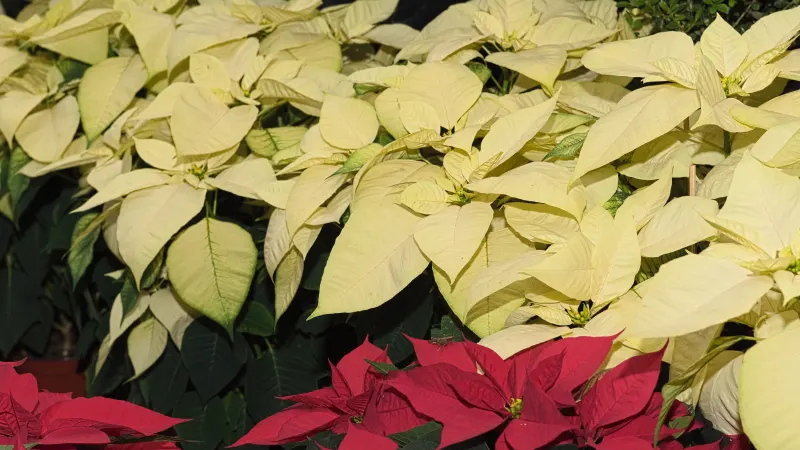
The red on a poinsettia is not a flower. It is a ring of leaves that changed colour because the nights grew long.
What a poinsettia is
The poinsettia is Euphorbia pulcherrima, a member of the spurge family, Euphorbiaceae. The RHS describes it as a semi-evergreen shrub with large, bluntly toothed oval leaves, native from Mexico to Guatemala. In the wild it is no table plant: NC State Extension gives it up to about 3 m tall in its native coastal and dry tropical forests, where a potted plant rarely passes 60–90 cm.
The part everyone buys it for is not a flower. The red, pink, cream or salmon "petals" are bracts, modified leaves that colour up around the true flowers. The flowers themselves are the small yellow buttons in the centre of each cluster, called cyathia. They have no true petals, and Clemson HGIC notes that the coloured bracts are there to draw insects to them.
That colour is switched on by the length of the night. The RHS explains that poinsettias colour in response to short days, which is why they turn red for the darkest weeks of the year and why getting one to colour again at home comes down to controlling darkness, as described further down. Commercial growers also treat most plants with growth suppressants to keep them compact, so a plant you grow on at home tends to grow taller and looser than the one you bought.
Bringing one home in winter
The first risk is the trip home. The RHS puts the plant's minimum at 13–16°C, and says that cooler conditions cause physiological shock. Iowa State University Extension goes further: exposure to freezing temperatures, even for a brief moment, can make the leaves blacken and drop. A plant that has stood on a pavement or in a cold shop entrance can look fine on the day and start dropping leaves soon after.
Start in the shop. Choose a plant with dark green leaves all the way down the stems, no wilting, no broken stems and no insects, and bracts that are fully coloured without yellow or brown edges. Look at the yellow cyathia in the centre: Clemson HGIC suggests choosing a plant whose little flowers are not yet fully open, and Iowa State suggests one that is shedding little or no pollen. Turn a few leaves over too: whitefly is the poinsettia's most common pest, and Iowa State says inspecting before you buy is the best prevention.
Then get it home warm. Iowa State's advice is to buy the poinsettia last, have it covered with a sleeve or bag before it goes outside, and take it straight from a warm shop to a warm car to a warm house. Do not leave it in the car while you run another errand. The RHS adds that a mild day is better than a frosty one for buying.
If the leaves start wilting and dropping soon after you get it home, the RHS warns that the damage was most likely done before you bought it, in a chilly shop or pavement spot, and that it usually carries on whatever you do. Give it good conditions and let it run its course: the leaves usually fall over a couple of weeks, a few at a time.
For the first days with any new plant, the new houseplant checklist covers the rest.
Light: bright, out of direct sun, away from the glass at night
A poinsettia wants bright light but not the direct beam. The RHS suggests a table a little way back from a living-room window as the ideal spot, and Clemson HGIC asks for at least six hours of bright, indirect light a day, warning that direct sun can fade the bracts. If the only bright spot gets direct sun, filter it with a sheer curtain.
The RHS lists the places to avoid: windowsills above radiators, where the heat dries the plant; the gap behind drawn curtains at night, against cold glass; draughty hearths; and unheated rooms such as porches. Iowa State adds that the leaves should not touch cold window glass.
If you track your plants in Botanical Legacy, each place carries the light you described for it, a level or the window's direction. When a plant's light needs and its place don't match, the app flags it and names a better place you already have.
How often to water a poinsettia
There is no fixed interval, and overwatering is the commoner mistake. The RHS advice is to water sparingly, only when the surface of the compost feels dry, and to keep the compost just moist. Iowa State suggests checking it by touch every day.
When it is dry, water it properly:
- Take it out of its cover. Clemson HGIC says to remove a foil or decorative pot cover before watering, and Iowa State suggests watering the plant in the sink, then returning it to the cover.
- Soak and drain. Water until it runs from the drainage hole, or follow the RHS method of standing the pot in tepid water for 10–20 minutes, then let it drain fully before it goes back in its cover.
- Never leave it standing in water. Iowa State says to empty the cover or saucer every time. Clemson HGIC adds the other half: do not let the compost dry out completely either.
Iowa State links overwatering to yellowing lower leaves, root rot and sudden collapse, and underwatering to curling, dropping leaves. For the general method, see when to water your houseplants.
This is where a model of the individual plant helps. Botanical Legacy keeps a Digital Shadow of each Specimen in your Sanctuary, a running estimate of when that particular pot will be dry. On every plan, including the free one, you can log a quick soil check from the Specimen's page, from bone dry to wet. After three checks between waterings, the model starts correcting its drying rate for that plant from what you found. For a poinsettia in a small pot on a warm sideboard, that means a schedule fitted to this pot, in this room, rather than to a label.
Temperature and humidity
Steadiness is what a poinsettia wants. The RHS recommends a fairly consistent 16–21°C and a minimum of 13–16°C, and Iowa State gives a similar preferred range. Clemson HGIC sets the warning line lower: chilling injury can occur below 10°C, and daytime temperatures are best kept below about 21°C. The RHS rates the species H1B, hardy only to 10–15°C, so in the UK it is a houseplant that can go outside, at most, in summer.
Cold draughts are the usual trouble at home. Keep it away from external doors that open often, and from cold hearths. Heat does damage too: Clemson HGIC says to keep it away from the dry air of appliances, fireplaces and heating vents, and the RHS warns against radiator shelves.
Humidity helps the display last. The RHS notes that humid air extends flowering time and suggests misting the plant daily if you can. Central heating dries the air, one more reason to keep it away from radiators and vents.
After Christmas: compost it or keep it
Most poinsettias are treated as a seasonal plant. The RHS says they are usually discarded a few weeks into the new year, and Iowa State suggests composting it once it looks tired. Keeping one is a project: NC State Extension describes getting a second year of colour as taking considerable effort, and only a healthy plant is worth it.
If you want to keep it, here is the year in outline:
- Winter, while it is in colour. Clemson HGIC advises no fertiliser while it is in bloom. The RHS says to feed only if you plan to keep the plant into the new year, and then with a high-potassium feed such as tomato feed, once a month.
- Spring: cut it back. When the bracts fade, cut the stems back hard. The RHS says to prune in April to about 10 cm, and Iowa State suggests March, to 10–15 cm above the compost. Keep it at about 13°C until you repot. Wear gloves: the RHS warns that the milky sap that runs from cut stems can irritate skin and eyes.
- May or June: repot. The RHS suggests repotting in early May, into three parts peat-free John Innes No 3 to one part grit. Clemson HGIC suggests early June, into a pot 5–10 cm larger.
- Summer: grow it on. The RHS suggests a light, cool place at 15–18°C. Feed through the growing season: Clemson HGIC suggests a balanced fertiliser every two to three weeks from spring to autumn. Pinch out the shoot tips once or twice to keep it bushy, and stop pinching after 1 September, Clemson's cut-off. Clemson also suggests that in a warm climate the plant can go outside once nights stay above 10°C, coming back in before nights fall to 13–16°C.
With no growth suppressant, the RHS notes, home-grown plants go back to their taller natural habit.
Getting it to colour again: the long-night routine
The bracts colour because of long nights, so a poinsettia that spends autumn in a lit living room usually stays green. The fix is to give it long, unbroken nights, every night, for about two months.
- When to start. The RHS says to start shortening its days from late September for Christmas colour. Clemson HGIC starts in the first week of October, and Iowa State in early October.
- How long the night must be. The RHS aims for less than 12 hours of light a day. Clemson HGIC asks for 14 continuous hours of total darkness, Iowa State keeps it dark from 5 pm to 8 am (15 hours), and NC State Extension gives 16 hours of darkness with 8 of bright light. The common thread is a long night with no light at all, every night.
- How dark is dark. A cupboard, a dark room or a large cardboard box. The RHS warns that room lights switched on in the evening are enough to undo it, and Oregon State University Extension says interrupting the darkness for even a few minutes can prevent colouring.
- What it needs by day. Bright light: Clemson HGIC suggests six to eight hours of bright sun each day. Take it out of the dark each morning and back in each evening.
- Keep it steady. The RHS recommends a constant temperature of about 18°C for good colour.
- For how long. The RHS gives 8–10 weeks of short days on average, and Clemson HGIC the same. Iowa State says to continue until the bracts are well coloured, usually by early December.
Oregon State notes that once the bracts are coloured, the plant can go back to normal light, and room lights will not stop the display.
Common problems
Leaves dropping soon after you bring it home. Almost always cold. The RHS traces most leaf and bract drop to chilly shop or pavement displays, and the drop can carry on for a couple of weeks. Move it somewhere warm and bright, away from draughts, and keep the compost just moist.
Leaves dropping later in the winter. Clemson HGIC lists temperatures below 10°C, poor light and poor nutrition as causes of early leaf drop. A spot behind the curtains at night, or near a door that opens onto the cold, is a common culprit.
Lower leaves turning yellow, then falling. Iowa State links this to overwatering. Check that the foil sleeve or cover is not holding water, and let the surface dry before watering again.
Wilting or curling. Oregon State University Extension notes that leaves can wilt when the plant is too dry, too wet or in a draught, and Iowa State links curling leaves to underwatering. Feel the compost first: dry compost means water, wet compost means stop watering and let it drain, and if neither, look for a draught.
Leaves blackened overnight. Cold damage, often from a few minutes in freezing air on the way home. Iowa State notes that cold damage cannot be cured, only prevented.
Grey, fuzzy mould on leaves or stems. The RHS names grey mould as a result of overwatering. Let the compost dry at the surface between waterings, and never leave the pot standing in water.
Tiny white insects that fly up when you touch it. Whitefly, the most common poinsettia pest according to Clemson HGIC. Iowa State explains that the adults lay eggs on the undersides of leaves, that insecticides are generally ineffective against them, and that a small infestation can be tolerated until the plant is composted after the holidays. Mealybugs, scale insects and spider mites also attack it. More on all of them is in common houseplant pests.
Frequently asked questions
Why is my poinsettia dropping its leaves?
Usually cold. The RHS traces most leaf and bract drop to the plant being chilled in a shop or on a pavement display before you bought it, and Iowa State notes that a brief exposure to freezing air can make leaves blacken and drop. Draughts at home, a night behind the curtains, poor light, and overwatering or underwatering all cause it too. Keep it at a steady 16–21°C, in bright light, with compost that is just moist.
How often should I water a poinsettia?
When the surface of the compost feels dry, not on a schedule. Check it by touch every day or two. Take it out of its foil or decorative cover, water until it drains from the base, let it drain fully and put it back, with no water left in the cover. The RHS's alternative is to stand the pot in tepid water for 10–20 minutes, then drain it. Overwatering is the commoner mistake.
How do I get my poinsettia to turn red again?
Give it long nights. From late September or early October, keep it in complete darkness for about 14 hours or more every night, in a cupboard or under a box, and in bright light by day, at a steady 18°C or so. Keep this up for 8–10 weeks, until the bracts colour. Even a few minutes of light during the dark period can undo it.
Is a poinsettia poisonous to cats and dogs?
The ASPCA lists it as toxic to cats, dogs and horses. Its irritant sap can upset the mouth and stomach and sometimes causes vomiting, and the ASPCA itself describes the plant as generally over-rated in toxicity. NC State Extension rates its poison severity as low. In people, a study of 22,793 poinsettia exposures reported to US poison centres found no deaths, and 92.4% of cases had no toxic effects. That makes it an irritant, not a deadly plant. It is still best kept out of reach of pets and children, and you should call your vet if a pet has eaten some and seems unwell.
Does poinsettia sap irritate skin?
It can. The RHS warns that the milky sap that runs from a broken leaf or stem can irritate skin and eyes, and suggests gloves when handling cut stems. NC State Extension adds that the sap can trigger a reaction in people with a latex allergy, and that it should be kept out of the eyes. If sap gets on your skin, Clemson HGIC suggests washing it off with soap and water, and flushing with water if it gets in your eyes.
Can Botanical Legacy help me keep a poinsettia alive past Christmas?
It helps with the part that kills most of them, the watering. Each Specimen gets its own Digital Shadow, an estimate of when its pot will be dry, and soil checks you log on any plan teach the model that plant's real drying rate. If you keep it into a second year, progress photos build growth curves of height and leaf count, so its regrowth after the spring cut-back shows up as a trend.
Start your sanctuary
Botanical Legacy's free Observer plan covers up to five Specimens, each with its own continuously running Digital Shadow and soil checks that teach it each pot's drying rate. A poinsettia, in a small pot, in a warm room, in the season you are busiest, is exactly the kind of plant a steady per-pot model is for. Every new account also includes a 14-day trial of Cultivator, the paid plan, which adds the local weather feed and soil sensor support.
START YOUR SANCTUARY - FIVE FREE SPECIMENS, NO PAYMENT REQUIRED →
Keep a poinsettia warm on the way home and dry-footed in the house, and the red lasts well past Christmas.
Sources
9 references
The plant-care facts on this page were checked against these references.
- RHS: rhs.org.uk/plants/88057/euphorbia-pulcherrima/details
- NC State Extension: plants.ces.ncsu.edu/plants/euphorbia-pulcherrima
- RHS: rhs.org.uk/plants/euphorbia/poinsettia/growing-guide
- Clemson HGIC: hgic.clemson.edu/factsheet/poinsettia
- Iowa State Extension: yardandgarden.extension.iastate.edu/how-to/guide-selection-and-…
- RHS: rhs.org.uk/plants/articles/graham-rice/house-or-conservatory-pl…
- Oregon State Extension: extension.oregonstate.edu/es/news/how-keep-poinsettias-blooming…
- ASPCA: aspca.org/pet-care/aspca-poison-control/toxic-and-non-toxic-pla…
- Krenzelok, Jacobsen & Aronis 1996, Am J Emerg Med: pubmed.ncbi.nlm.nih.gov/8906768