Plant care · 14 min read
New houseplant checklist - the pot, soil and light checks for the first two weeks
A new plant arrives set up for a greenhouse, not your home. What to check in the first two weeks - drainage, pot size, the soil it came in, the light it will live in, the pests it may have brought - and what to leave alone until it settles.
Botanical Legacy · Field notes ·
A new plant comes home in a pot, a soil and a light that were chosen for a greenhouse. The first two weeks are for finding out which of the three is wrong for your house.
It was grown for somewhere else
Every houseplant you buy has spent its life being optimised for a place you will never see. A commercial foliage greenhouse is bright, warm and humid, and it keeps the pots moist on a schedule set by the grower. The plant in your hands is the product of that system, and so is everything around it: the pot is the cheapest size that holds it to the point of sale, the soil is a peat-based mix built to be watered constantly under strong light, and the leaves were grown for light levels that no windowsill matches. Shaded greenhouse production commonly runs at 10,000 lux or more through the day. A bright room a metre back from the window often delivers a tenth of that.
None of that is a fault in the plant. It is a mismatch, and the mismatch is why so many healthy-looking plants go into a decline within a month of coming home. The popular explanation is that the buyer did something wrong. The usual truth is that the buyer did nothing different at all. They kept watering the way the greenhouse did, in a pot and soil that were designed for the greenhouse's drying rate, under a fraction of the light. The soil that dried quickly on the bench now stays wet for days on end.
The second popular idea is that a new plant should be repotted straight away into "proper" soil and a bigger pot. That instinct is half right. The nursery setup often is wrong for your home, but day one is the worst possible day to change it. A plant that has just been moved, boxed, chilled in a car and set down in a dimmer room is already losing leaves it can no longer support. Disturbing the roots in the same week asks it to regrow them with less light than it has ever had. The better order is to check everything now, fix only what is urgent, and change the rest once the plant has settled.
So the first two weeks are an inspection, not a makeover. Each check below tells you something about how fast this particular pot will dry, and together they decide how you water it for the rest of its life.
What to check, in order
Keep it apart for at least three weeks. Put the new plant in a room away from the rest of your collection before you do anything else. New plants are the usual way thrips, mealybugs, scale and spider mites get into a home, and a few hitchhikers on one plant can spread to all of them. Look under the leaves, in the leaf joints and along the stems. Fungus gnats are a common passenger, because damp, peat-rich compost is where they breed; small dark flies lifting off the soil when you water are the giveaway. The signs of each are in the guide to common houseplant pests.
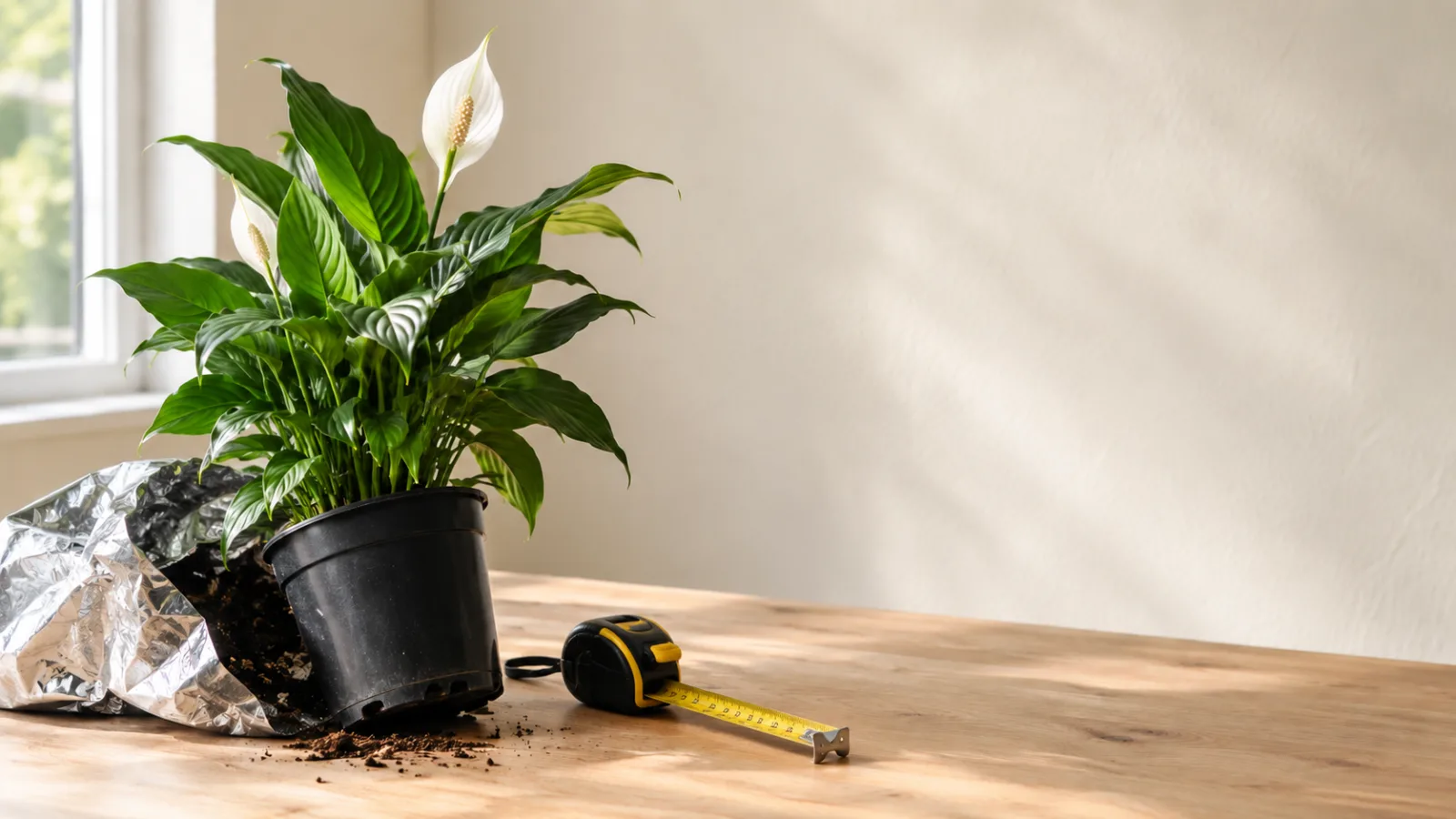
Look for the drainage hole, and take off the sleeve. Lift the plant and look underneath. Most nursery pots have holes, but many plants are sold inside a foil wrap, a plastic sleeve or a decorative pot with no hole at all, and water poured on top collects there out of sight. A peace lily can stand in two centimetres of water for weeks inside a pretty cachepot, and the first sign is yellow leaves and a smell. Remove every wrap. If you keep a decorative outer pot, lift the plant out to water it and let it drain before it goes back in. The beginners' guide covers why a gravel layer is no substitute for a hole.
Measure the pot. Nursery pots are sold by their top diameter - 12 cm, 17 cm, 21 cm - and the number is usually printed on the base. Write it down. The volume of soil around the roots is one of the biggest factors in how long the pot stays wet: a small pot on a bright sill dries in a matter of days, while the same plant in a much larger pot of the same soil stays wet far longer. Then look at the fit. If roots are coming out of the drainage holes, or the whole plant lifts out as a solid block of circling roots, it is pot-bound and will need moving up eventually. One size, a few centimetres wider, not three.
Find out what the soil is. Most foliage plants arrive in a fine, dark, peat-heavy mix that holds water like a sponge. That suits a pothos in a warm, bright spot and suffocates a succulent or a jade plant in a cool one. Look for three things. First, whether the soil is wet or dry a few centimetres down, since nurseries and shops keep plants moist and a plant that arrives saturated should not be watered again for days. Second, the small round beads scattered through it, which are slow-release fertiliser: a plant carrying them may already be fed for months. Third, a plug - a separate cylinder of different material, sometimes wrapped in paper or mesh, around the base of the stem. Some plants are potted up with the plug they were rooted in still in place, and because water moves poorly across the boundary between two different materials, a plug can stay bone dry or soaking wet while the soil around it tells you the opposite.
Note the pot material. Unglazed terracotta pulls water through its walls and dries the soil noticeably faster than plastic or glazed ceramic, which hold it in. Most plants arrive in plastic. If you plan to move it into clay later, expect the watering rhythm to change with it, as when to water houseplants explains in detail.
Choose its spot before you choose its schedule. Decide where the plant will live and leave it there. Which way the window faces and how far back the plant sits change its light far more than the species label suggests, and light sets how fast it uses water. Give a newcomer the brightest spot that suits its kind, away from radiators, heat vents and the draught of a door, then stop moving it. Every move is another adjustment, and a plant that changes rooms three times in its first fortnight never gets to finish the first one.
Leave the fertiliser and the repotting for later. A nursery plant is usually fed for weeks to come, and a newly moved plant has little capacity to regrow roots. Wait about four weeks, and in autumn and winter, wait for spring. The exceptions are urgent: no drainage and no way to lift it out, soil that is waterlogged and sour-smelling, or a plant so root-bound that water runs straight through. Those go into a pot with a hole, one size up, as soon as you find them.
Take a photo on day one. A clear picture of the whole plant, with its height and leaf count noted, is the only reliable way to tell later whether it is settling or declining. Memory is generous in the first week and pessimistic by the third, and the photo lets you read the signs against something fixed.
Three ways this plays out
The sleeve
A peace lily comes home from the supermarket in a glossy foil wrap, flowering, and goes on a side table. It droops on the fourth day, as peace lilies do when they are dry, so it gets a generous glass of water. It droops again a few days later and gets another. The foil holds every drop. By the third week the lower leaves are yellow and the stems are soft at the base, and the drooping that looked like thirst was roots failing in standing water. Lifting the pot on day one would have found the problem in a second: no hole in the sleeve, and a nursery pot sitting in a puddle.
The plug
A fiddle-leaf fig arrives in a 21 cm pot of fine peat. The surface dries, the finger test says the top few centimetres are dry, and it gets watered every week. Leaves start browning at the edges and dropping from the bottom. When it is finally lifted out, the answer is in the middle: a tight mesh-wrapped plug of coir around the base of the trunk, where almost all the roots are. Water poured on the surface ran around it and soaked the peat outside, which the roots barely touch. The plug itself had been close to dry for a month. Loosening the mesh at the next repot fixed it. Checking the core of the root ball, not only the surface, would have found it six weeks earlier.
The day-one repot
A calathea comes home in a 12 cm nursery pot and gets repotted that evening into a 20 cm ceramic pot of fresh compost, as a welcome. The new soil holds far more water than the small root ball can use, the room is dimmer than the greenhouse, and the plant has just been moved. Within two weeks the leaves are curling and the soil smells stale. Nothing in the nursery setup was urgent. Left in its 12 cm pot in a bright spot for a month, then moved up to 14 cm in spring, it would have settled without drama. The curling and the stale smell were the overwatering signs, produced by a pot the plant could not yet fill.
What Botanical Legacy does about it
Adding a plant to your Sanctuary asks several of the questions on this checklist, because the answers change how the plant's Digital Shadow dries the pot between waterings.
Where it lives comes first. Before the camera opens, you choose the room or outdoor spot the Specimen lives in. That place carries the light you described when you set it up - a light level, or the direction its window faces - and the Digital Shadow uses it to set how quickly this plant draws water. It also decides whether the plant is modelled indoors or against local weather outside. If the plant's light needs and the place don't match, the Specimen's page says so and, where you have one, names a place that would suit it better.
The photo reads the pot and the soil. The identification photo is analysed by Botanical Vision v5, which names the species and estimates the pot size and how freely the soil looks to drain from what it can see. Both go into the model. Without a sensor, a larger pot is modelled as drying more slowly, because it holds more water - deliberately gently, since doubling the pot's volume slows the estimate by about a fifth. When the photo leaves the pot size unclear, the app asks you to confirm it when you next log a watering.
Then a short intake sheet, with the estimates filled in. You can keep them or correct them: pick the pot size from a list and the model follows it, record the soil mix by name, or mark a plant as growing in the ground. The sheet also asks when the plant was last watered. Answer "today", "yesterday", "a few days ago" or "about a week ago" and that watering is recorded at that time, so the first reminder starts from the plant's real state instead of assuming it was watered the moment you added it. "Not sure" leaves the model's own starting estimate in place. Pot size and soil can be changed later from the Specimen's page, and a repot logged with its new pot and soil updates the record at the same time.
Your finger test can teach it. On the paid plan, the Specimen's Shadow tab lets you log a quick soil check - bone dry, dry, damp, moist or wet. Log three of those between waterings and the model starts correcting its drying rate for that plant from what you found, which is how the first weeks' checking turns into a schedule that fits this pot, in this room. A soil-moisture sensor connected through Home Assistant does the same thing continuously, and a fresh reading overrides the estimate.
The first photo becomes the baseline. The identification photo is saved as the first picture in the Specimen's gallery, with an estimated height and leaf count, where the photo allows one, as the starting point for its growth curves, and the next progress photo comes due two weeks later. If the plant starts dropping leaves in the meantime, a photo to the Doctor - powered by Botanical Vision v5 - compares it with the previous picture and gives you a second opinion on whether it's adjustment, water or something that came home with it. Identification and diagnosis draw on the same monthly photo allowance.
What the model can't see
It doesn't know what the pot is made of or whether it has a hole. The Digital Shadow models the volume of soil, not the material around it, so a terracotta pot that dries faster than plastic, a foil sleeve holding water, or a propagation plug staying dry inside wet peat are all invisible to it. Those are the checks you make with your hands on the first day. The soil check is how their effect reaches the model: when the pot dries faster or slower than the estimate, three logged checks between waterings tell it so.
It also can't see under a leaf. There is no quarantine setting and no pest scan on a new Specimen; the weeks apart, and the look under the leaves, are yours to do. What the app contributes is the part that is hard to hold in your head across a dozen plants - which pot is due, by how much, and whether each newcomer is drying the way its species label says it should.
Frequently asked questions
What should I do when I bring a new houseplant home?
Keep it apart from your other plants for at least three weeks and check it for pests. Remove any foil wrap or sleeve and make sure the pot drains. Measure the pot, check whether the soil is wet a few centimetres down, and put the plant in the spot where it will live. Hold off on fertiliser and repotting until it has settled.
Should I repot a new plant straight away?
Usually not. A newly moved plant is already adjusting to less light and a new room, and disturbing the roots adds stress it can do without. Wait about four weeks, or until spring if you buy it in autumn or winter. Repot immediately only if the pot has no drainage, the soil is waterlogged and sour, or the plant is so root-bound that water runs straight through.
Why is my new plant dropping leaves?
Most often because your home is darker than the greenhouse it grew in. The plant sheds leaves it built for stronger light and can no longer support. Keep it in one bright spot, water only when the soil has dried to the right depth, and do not feed or repot it. Most plants settle within a few weeks. Soft yellow leaves with wet soil point to overwatering instead, which is worth ruling out first.
Should I water a new plant when I get it home?
Only if the soil is dry a few centimetres down. Nurseries and shops keep plants moist, and many arrive with soil that will stay wet for days. Check first, and water when the soil says so rather than to mark the occasion.
How long should I quarantine a new houseplant?
At least three weeks is the usual advice. That is long enough for eggs and small populations missed on day one to become visible, while the plant is still on its own. Check under the leaves and in the leaf joints every few days during that time.
How do I know what soil my new plant is in?
Look and feel. Fine, dark, spongy material is peat-based nursery mix. Chunks of bark and white perlite mean a more open mix. Round beads are slow-release fertiliser. A cylinder of different material around the stem, sometimes wrapped in mesh, is a propagation plug. If the plant is a succulent, cactus or orchid in dense peat, plan to move it into the right mix once it has settled.
Does Botanical Legacy use my plant's pot size and soil?
Yes, through the identification photo. Botanical Vision v5 estimates the pot size and how freely the soil drains, and the Digital Shadow uses both: without a sensor, a larger pot is modelled as drying more slowly. You can correct the pot size after adding the plant and the model follows it. It does not record pot material or drainage, so on the paid plan the soil checks you log teach it how fast your particular pot dries.
Start your sanctuary
Botanical Legacy's free plan covers up to five Specimens, indoors or out, with continuous Digital Shadow modelling included. Every new account also gets a 14-day trial of the paid plan, which adds soil checks that teach each Specimen's drying rate, local weather, and sensor support - the layer that learns how your pots dry so you don't have to guess.
Start your sanctuary - five free specimens, no payment required →
The greenhouse chose the pot, the soil and the light. Two weeks of checking is how you learn which of them to keep.
Sources
The plant-care facts on this page were checked against these references.
- UF/IFAS EP150: ask.ifas.ufl.edu/publication/EP150
- UF/IFAS EP161: ask.ifas.ufl.edu/publication/EP161
- UF/IFAS Gardening Solutions: light: gardeningsolutions.ifas.ufl.edu/plants/houseplants/light-for-ho…
- University of Missouri IPM: ipm.missouri.edu/MEG/2016/11/Houseplant_Acclimatization
- RHS houseplants: rhs.org.uk/plants/types/houseplants/growing-guide
- RHS: how plants lose water: rhs.org.uk/advice/understanding-plants/how-plants-lose-water
- RHS calathea: rhs.org.uk/plants/calathea/growing-guide
- Colorado State Extension: extension.colostate.edu/resource/managing-houseplant-pests
- Illinois Extension: extension.illinois.edu/houseplants/care
- RHS fungus gnats: rhs.org.uk/biodiversity/fungus-gnats
- RHS: how plants absorb water: rhs.org.uk/advice/understanding-plants/how-plants-absorb-water
- WSU Extension (Chalker-Scott): wpcdn.web.wsu.edu/wp-puyallup/uploads/sites/403/2015/03/contain…
- RHS overpotting: rhs.org.uk/prevention-protection/overpotting
- Illinois Extension: watering: extension.illinois.edu/houseplants/watering
- RHS: how to repot: rhs.org.uk/container-gardening/how-to-repot-a-plant
- Illinois Extension: repotting: extension.illinois.edu/houseplants/repotting
- MBG jade: plantfinder.mobot.org/PlantFinderDetails.aspx
- RHS: poorly houseplant: rhs.org.uk/plants/types/houseplants/how-to-help-a-poorly-housep…
- RHS moth orchids: rhs.org.uk/plants/phalaenopsis/growing-guide
- Illinois Extension: lighting: extension.illinois.edu/houseplants/lighting
- Nebraska Extension: lancaster.unl.edu/houseplants-humidity