Species care guide
Cyclamen
Cyclamen persicum
How to care for a florist's cyclamen indoors: why it needs a cool room, how to water it from below without rotting the tuber, why the leaves turn yellow, and what to do after flowering, when it goes dormant for the summer.

- Light
- Bright, filtered light out of hot direct sun; too little light gives weak growth and smaller flowers
- Water
- When the surface of the compost is dry; water from below or at the pot's edge, never into the crown, and never leave it standing in water
- Humidity
- Moderate humidity; keep it away from radiators, heating vents and hot, dry air
- Temperature
- Cool: about 16–18°C by day and near 10°C at night; flower buds can fail above about 21°C
- Pets & toxicity
- Toxic to cats, dogs and horses; terpenoid saponins, and a large amount of tuber can be serious
- Difficulty
- Easy to keep in flower in a cool, bright room; hard to bring back into flower after its summer rest
A cyclamen flowers through the cool, damp half of a Mediterranean year. A warm living room tells it that summer has come.
What a florist's cyclamen is
The cyclamen sold in flower in winter is the florist's cyclamen, bred from Cyclamen persicum. University of Wisconsin Extension notes that many cultivars have been bred from the species, especially in England, Germany and the Netherlands, to enlarge the flowers, widen the colour range and change the shape of the petals. Today they are mass-produced as pot plants from hybrid seed. Illinois Extension dates the breeding to the mid-1800s; the plant itself had reached Western Europe in the 17th century, according to NC State Extension.
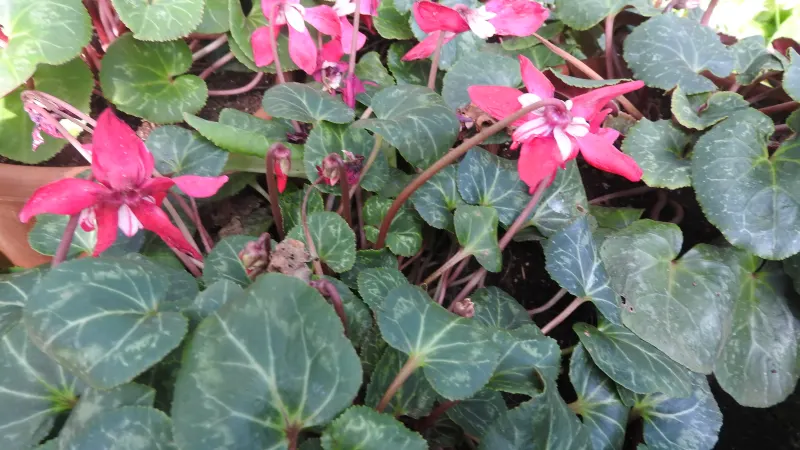
The leaves and flowers grow in a rosette from a rounded tuber at the base, and University of Missouri IPM notes that the name comes from the Latin for wheel, after that round tuber. The leaves are heart-shaped and dark green, often marbled with silver. The flowers rise above them on slender stalks, each with five petals swept back and twisted, in white, pink, lavender, magenta and red. The RHS describes the species as growing 10–20 cm tall, and the flowers of the wild plant are fragrant, though NC State Extension notes that some cultivars have no scent.
In the wild, Cyclamen persicum grows from Algeria to the eastern Mediterranean, in pine forests, oak thickets and on rocky slopes. It is frost tender: the RHS rates it H1C, a plant that can stand outside in summer but needs protection over winter. Because it will not tolerate frost and flowers in winter, Wisconsin Extension notes, it is grown mainly as a houseplant. With good care, both Wisconsin and NC State Extension say, a plant can stay in bloom for up to about three months, from early winter into spring.
Why a cyclamen wants a cool room
Everything about a cyclamen makes sense once you know its calendar. Iowa State Extension describes its native habitat as cool sites with an annual cycle of moist and dry seasons. The plant grows and flowers in the cool, wet months, then rests through the hot, dry summer, living on what it stored in the tuber. Illinois Extension calls that summer rest estivation, from the Latin for "summer sleep".
A centrally heated living room in December sends the wrong signal. Clemson HGIC and University of Wisconsin Extension both give ideal temperatures of about 16–18°C by day and around 10°C at night. Above about 21°C, Clemson warns, the flower buds fail to develop, and University of Missouri IPM says high temperatures make immature buds abort. University of New Hampshire Extension adds that in heat the leaves turn yellow quickly and the buds die.
That is why so many cyclamen bought in full flower look tired a few weeks later. Kept too warm, the plant does what a cyclamen does when the weather turns hot: it gets ready to sleep. Illinois Extension advises keeping it no warmer than about 20°C by day to make the flowers last, so the cooler you can keep it, within those limits, the longer it flowers. A bright spare bedroom, a cool hallway with a window, or an unheated porch that never drops below about 10°C all suit it better than the warmest room in the house.
Light: bright, but not hot
A cyclamen wants bright light. The RHS recommends bright, filtered light and advises avoiding direct sun, and Wisconsin Extension says the same: bright, indirect light. NC State Extension notes that low light leads to weak growth, smaller blooms and paler leaves, and Clemson HGIC warns that light levels in many homes are not high enough, which gives weak plants with small flowers.
The answer is a bright window in a cool room. What it does not want is to sit above a radiator in the sun: University of Missouri IPM says never to place a cyclamen near a heat register or hot air duct, and Clemson notes that heat vents dry the compost too fast.
If you use Botanical Legacy, the place you put a Specimen in carries the light you described for it, as a level or as the window's direction. When a plant's light needs and its place don't match, the app flags it and names a better place you already have. It cannot measure the light or the temperature of the room, so finding the cool, bright spot is still your job.
How to water a cyclamen
Watering is where most cyclamen go wrong, in both directions. The tuber and the crown, the point where the leaf and flower stalks emerge, rot if they stay wet. Iowa State, Wisconsin and New Hampshire Extension all say to keep water off the crown, and NC State Extension warns that wetting it can rot the tuber. Yet University of Missouri IPM is just as firm that a cyclamen should never be allowed to wilt, and that even watering is critical: the first sign it is short of water, besides wilting, is yellow leaves.
So water often enough, and in the right place. Iowa State Extension suggests checking the compost daily and watering thoroughly when the surface is dry to the touch, with water at room temperature. Clemson HGIC recommends watering along the edge of the pot or from below, so the tuber does not rot. The RHS method for its cyclamen is to stand the pot in a shallow tray of water, let the plant take up what it needs, then let it drain.
Whichever way you water, never leave the pot standing in water: University of Missouri IPM ties it to root rot. And do not water by the calendar. A cyclamen in a cool room dries more slowly than the same plant in a warm one, and a plant heading into dormancy needs less every week. The longer method is in when to water your houseplants.
A model of the individual plant helps here. Botanical Legacy keeps a Digital Shadow of each Specimen in your Sanctuary, a running estimate of when that particular pot will be dry. On every plan, including the free one, you can log a quick soil check from the Specimen's page, from bone dry to wet. After three checks between waterings, the model starts correcting its drying rate for that plant from what you found. For a cyclamen, which suffers from too much water and from too little, that means a timing fitted to this pot in this room, rather than to a label.
Temperature, humidity and feeding
While it flowers, the target is the extension range above; Iowa State Extension gives a similar 10–16°C. The RHS sets a winter minimum of 13–16°C for the species and recommends moderate humidity, away from draughts and hot, dry air. Illinois Extension adds that hot or cold draughts can make the flowers drop. A cool room is the goal; a cold draught from a door is not.
University of New Hampshire Extension lists low humidity, along with heat and poor light, as a reason the leaves yellow and buds die, so keeping it away from radiators does double duty.
Feed while it grows. The RHS recommends a low-nitrogen liquid feed every fortnight, and Wisconsin Extension suggests a low-nitrogen fertiliser or a food for flowering houseplants every two weeks while it is growing actively. More is not better: Wisconsin warns that too much nitrogen gives soft, lush growth that is more prone to disease. Stop feeding when the leaves start to fade at the end of the season.
After flowering: summer dormancy and bringing it back
When flowering ends, usually in late spring, the leaves turn yellow and die back. This is the plant's summer rest, not its death, and Clemson HGIC describes it as natural. Illinois Extension explains that the tuber holds water and nutrients to carry the plant through it. Many people treat a cyclamen as a seasonal plant and throw it away at this point, and Iowa State Extension notes that it is often discarded after flowering. Wisconsin Extension calls cyclamen fairly easy to grow but notes that the conditions for reflowering can be hard to provide. If you want to try, this is the method.
Let it wind down. Iowa State Extension advises reducing water gradually after flowering, to mimic the dry season, and removing the foliage once it has died back. Stop feeding.
Rest it cool and shaded. Iowa State suggests six to eight weeks in late spring and early summer, in a cool, shaded place at about 7–10°C. Wisconsin Extension describes a dormancy of two to three months. How dry to keep it is where sources differ. The RHS says to keep it dry while dormant, and University of Missouri IPM suggests no water at all for six to eight weeks. Clemson HGIC, by contrast, says to keep the compost from drying out completely. Between the two, the safe ground is very little water: enough that the compost is not bone dry for months, never enough to sit wet around a resting tuber.
Wake it up. In mid to late summer, Iowa State Extension says, give it slightly warmer conditions, about 10–18°C, and begin watering to encourage new growth. Clemson HGIC expects new leaves to start in mid-September, and says to keep the resting plant in shade until they do, then move it into a bright place. Water thoroughly from then on, by the same rules as before.
With good light, steady moisture and cool temperatures, Clemson says, a rested cyclamen can flower again by midwinter.
Soil, repotting and the tuber
The time to repot is at the end of the rest, before growth gets going. Iowa State Extension advises replanting the tuber in fresh compost then, with its top slightly above the surface. The RHS recommends a peat-free, loam-based compost, with the tops of the tubers just above the compost, and Wisconsin Extension a well-drained potting mix with the upper half of the tuber exposed. University of Missouri IPM also suggests leaving about half the tuber above the soil line.
The depth matters more than the recipe. A tuber buried deep keeps damp compost against its crown, the very thing every watering rule above is meant to avoid. Plant it high, in a pot with a drainage hole.
Common problems
Yellow leaves. Ask first what time of year it is. Leaves yellowing in late spring, after flowering, are the start of dormancy, and Illinois Extension notes that as the weather warms the leaves yellow and the plant goes dormant. Yellow leaves in midwinter, with buds still coming, point to the room. University of New Hampshire Extension lists heat, low light and low humidity, Wisconsin Extension notes that plants kept too moist or too dry develop yellow leaves, and University of Missouri IPM calls yellow leaves the first sign of too little water. Check the temperature, then the compost. More on reading the colour of a leaf is in why plant leaves turn yellow.
Buds that wither before they open. Usually too warm. Clemson HGIC says buds fail above about 21°C. Move it somewhere cooler.
A plant that collapses. There are three common causes. If the compost is dry, it is thirst: water it, and keep it from wilting again. If the compost is wet and the tuber feels soft, the cause is rot from overwatering, which Wisconsin and NC State Extension both link to a wet crown. If the compost is moist and the plant still wilts, tip it out and check the roots for vine weevil grubs.
Grey mould. The RHS describes cyclamen grey mould, caused by the fungus Botrytis cinerea, as small discoloured spots on the flowers, then collapsing stalks on developing leaves and flowers and, in humid air, a fuzzy grey-brown mould on the dead tissue. It often gets in through wounds or stressed tissue, though it can attack healthy plants too. There are no chemical controls for home gardeners. The RHS advice is to remove dead leaves and flowers promptly, keep the area clean, improve airflow and avoid crowding plants together. That is the reason to twist a dead flower stalk away completely rather than leave a stub.
Vine weevil. Container plants are most at risk. The RHS describes the grubs as plump, C-shaped, white and legless, with light brown heads and up to 1 cm long. They eat roots and can bore into cyclamen tubers, causing wilting and death, most often between September and March. When you repot, remove as many grubs as you can from the roots and compost. Biological control with nematodes is possible, though the RHS advises using them only when there is a specific problem.
Cyclamen mite. The RHS lists Tarsonemus pallidus, cyclamen mite, among its pests. The mites are about 0.2 mm long and need 20–40x magnification to see, according to UC IPM, and feed inside buds and unfolding leaves. Leaves become cupped and thickened, and new growth stunted and distorted. University of Missouri IPM notes that stunted or curled young leaves may be the first sign. Wisconsin Extension and Clemson HGIC both advise discarding an infested plant, as the pest is extremely hard to control, before it spreads to others.
Other pests. Clemson HGIC and Wisconsin Extension list aphids, mealybugs, spider mites and thrips, which insecticidal soap can control. See the guide to common houseplant pests for how to tell them apart.
Frequently asked questions
How often should I water a cyclamen?
There is no fixed interval. Check the compost every day or two and water when the surface is dry to the touch, as Iowa State Extension suggests. Water from below or at the edge of the pot, keeping water off the crown and tuber, and never leave the pot standing in water. A cyclamen should not be allowed to wilt, but a wet tuber rots, so steady, moderate moisture is the aim.
Why are my cyclamen's leaves turning yellow?
If it is late spring and flowering has ended, it is going dormant, and that is normal. If it is winter and the plant is still flowering, the usual cause is a room that is too warm, too dark or too dry: University of New Hampshire Extension lists all three. Compost kept too wet or too dry also yellows leaves. Move it somewhere cooler and bright, away from radiators, and check the compost.
What do I do with a cyclamen after it has flowered?
Let it rest. Reduce watering gradually as the leaves yellow, remove them once they have died, and keep the pot in a cool, shaded place for six to eight weeks or more. In mid to late summer, start watering again in slightly warmer conditions, repot if needed with the top of the tuber above the compost, and move it into bright light once new leaves appear. Reflowering is possible but not guaranteed.
Can a cyclamen live indoors all year?
Yes, if it gets a summer rest. It is frost tender, so it spends winter indoors, and the RHS rates it H1C: it can go outside in summer, but it does not need to. What it needs is a cool, bright spot while in leaf and a cool, shaded rest after flowering. A warm room is what cuts its flowering short.
Is cyclamen toxic to cats and dogs?
Yes. The ASPCA lists cyclamen as toxic to dogs, cats and horses. The toxic compounds are terpenoid saponins, causing drooling, vomiting and diarrhoea. After large amounts of tuber, the ASPCA lists heart rhythm abnormalities, seizures and death. NC State Extension notes that the tubers and stems are the toxic parts, and the RHS advises wearing gloves when handling the tubers. Keep it out of reach, and call your vet if a pet has chewed it, especially the tuber.
Can Botanical Legacy help with a plant this particular about water?
It helps most with exactly that problem. A cyclamen dies of too much water as easily as too little, and how fast its pot dries depends on the room. Each Specimen gets its own Digital Shadow, an estimate of when its pot will be dry, and soil checks you log on any plan teach the model that plant's real drying rate. Progress photos build growth curves of height and leaf count, so a cyclamen's new leaves in autumn show up as a trend instead of a guess.
Start your sanctuary
Botanical Legacy's free Observer plan covers up to five Specimens, each with its own continuously running Digital Shadow and soil checks that teach it each pot's drying rate. A cyclamen, which rots when kept too wet and wilts when kept too dry, is exactly the kind of plant a steady per-pot model is for. Every new account also includes a 14-day trial of Cultivator, the paid plan, which adds the local weather feed and soil sensor support.
START YOUR SANCTUARY - FIVE FREE SPECIMENS, NO PAYMENT REQUIRED →
Keep a cyclamen cool, bright and dry at the neck, and it treats your winter as its own.
Sources
13 references
The plant-care facts on this page were checked against these references.
- University of Wisconsin Extension: hort.extension.wisc.edu/articles/cyclamen
- Illinois Extension: extension.illinois.edu/blogs/extensions-greatest-hits/2009-12-0…
- NC State Extension: plants.ces.ncsu.edu/plants/cyclamen-persicum
- Clemson HGIC: hgic.clemson.edu/factsheet/cyclamen
- University of Missouri IPM: ipm.missouri.edu/MEG/2011/2/Cyclamen-Hearts-and-Flowers
- RHS: rhs.org.uk/plants/101163/cyclamen-persicum-persian-cyclamen/det…
- Iowa State Extension: yardandgarden.extension.iastate.edu/how-to/all-about-cyclamen
- UNH Extension: extension.unh.edu/resource/care-flowering-gift-plants-home-fact…
- RHS: rhs.org.uk/plants/529612/cyclamen-persicum-illusia/details
- RHS: rhs.org.uk/disease/cyclamen-grey-mould
- RHS: rhs.org.uk/biodiversity/vine-weevil
- UC IPM: ipm.ucanr.edu/agriculture/floriculture-and-ornamental-nurseries…
- ASPCA: aspca.org/pet-care/aspca-poison-control/toxic-and-non-toxic-pla…