Species care guide
Gardenia
Gardenia jasminoides
How to care for a gardenia as a houseplant: the bright light and cool nights it needs to keep its buds, why it wants ericaceous compost and rainwater, and what yellow leaves and bud drop are telling you.

- Light
- Bright light out of hot direct sun; the RHS calls a west-facing windowsill ideal, and a south-facing one in winter
- Water
- Keep the compost evenly moist, never soggy or dry; use rainwater at room temperature, especially in hard water areas; water a little less in winter
- Humidity
- High and steady; stand the pot on a tray of damp gravel and keep it away from radiators and hot, dry air
- Temperature
- 21–24°C by day and 15–18°C at night; steady temperatures matter, and nights of 18°C or more stop flowering
- Pets & toxicity
- Toxic to cats, dogs and horses per the ASPCA; mild vomiting, diarrhoea and hives
- Difficulty
- Challenging; it needs acid compost, soft water, humid air and cool nights all at once
A gardenia keeps its buds on one condition: that tonight is cooler than today, and tomorrow is much like today.
What a gardenia is
The gardenia sold as a houseplant is Gardenia jasminoides, also called cape jasmine, a woody evergreen shrub in the coffee family, Rubiaceae. You may still see it labelled under its older names, Gardenia augusta or Gardenia florida. It comes from East Asia: the RHS gives its range as China and Japan, and NC State Extension adds Taiwan and Vietnam, noting that it grew along the stream banks of southern China and Japan. Clemson Extension points out that the Chinese have grown it for over a thousand years. The name honours Alexander Garden, an eighteenth-century Scottish naturalist.
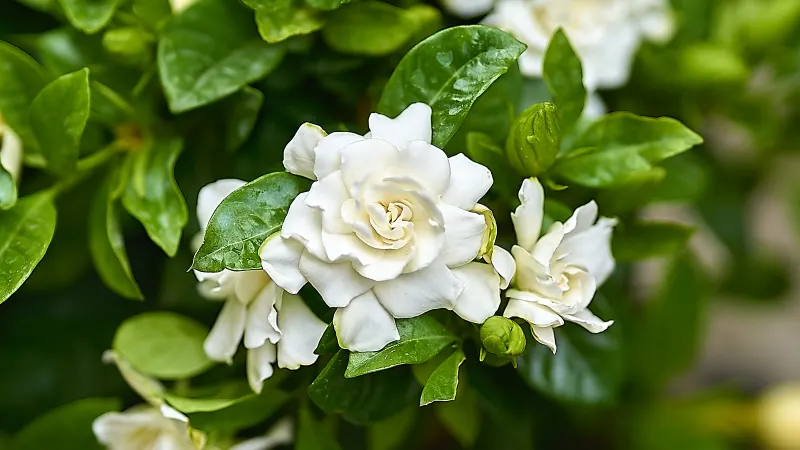
It is grown for two things: glossy, dark green leaves and very fragrant, waxy white flowers. The RHS describes the blooms as broadly funnel-shaped and about 8 cm across, opening in summer and autumn, and gives the species its Award of Garden Merit. In the ground, where winters allow, it is a shrub of a metre or more. In the UK, the RHS notes, it is mainly grown as a flowering houseplant, kept indoors all year and moved outside only in the warmest months.
Most gardenias reach a home in spring or summer, already in bud or in full flower. What happens next depends on whether the room can give it what the greenhouse did.
Why a gardenia is so fussy
Gardenias have a reputation, and the sources agree it is earned. The RHS says some care and attention are needed to get the conditions right, and that gardenias are often treated as short-lived plants for that reason. Iowa State University Extension goes further: a florist's gardenia is very difficult to bring back into flower in the home. University of Arkansas Extension puts it plainly: gardenias grown indoors need special care.
The difficulty is that a gardenia needs several things at once, and most homes give it only some of them:
- Acid compost and soft water. Without them the leaves yellow.
- Bright light. Without it the buds fall and the shoots go pale.
- High, steady humidity. Dry air stops flowering and drops buds.
- Cool nights and steady temperatures. This is the one most homes miss.
The last point is the one to understand. Missouri Botanical Garden explains that buds develop best when nights are about 16–18°C. If nights rise above about 21°C, the buds drop, though the plant keeps growing leaves. The RHS adds that nights of 18°C or more, together with dry air, can stop it flowering at all. A centrally heated living room, warm day and night, is exactly the wrong place. So is a spot that swings between cold and hot: the RHS lists extreme or fluctuating temperatures, along with too much, too little or irregular watering, as the usual causes of bud drop.
So a gardenia that drops its buds is rarely ill. It is reporting on its room. Read the problems section below with that in mind.
Light: bright, but out of hot sun
A gardenia needs good light to flower. University of Arkansas Extension lists low light, alongside high temperature, as a cause of bud drop, and Missouri Botanical Garden notes that leaves can yellow and fall after a move indoors, when the light drops and the temperature rises. Iowa State Extension asks for bright light, but not direct sunlight.
The RHS recommends a warm, bright spot out of direct sun, and calls a west-facing windowsill ideal. Strong, hot sun can scorch the leaves or make them wilt. In winter, when days are short, the RHS suggests moving the plant to a south-facing windowsill to catch as much light as possible. Give it some air movement, but no cold draughts.
If you are not sure which of your rooms fits, the places you set up in Botanical Legacy can help. A place in the app carries the light you described for it, as a level or as the direction its window faces. When a plant's light needs and its place don't match, the app flags it and names a better place you already have.
Watering and water quality
A gardenia wants its compost evenly moist. The RHS advice is to keep it constantly moist but not saturated through spring and summer, and in winter, when the plant is not growing, to water less without letting the compost dry out. Missouri Botanical Garden says the same in different words: evenly moist, never soggy, and never standing in water. Iowa State Extension suggests checking the compost often and watering promptly once the surface is dry.
There is no fixed interval. A pot dries faster in a bright, warm window than in a cool one, and faster in summer than in winter. Feel the compost, and water when the surface has dried. A gardenia punishes both extremes, and irregular watering on its own is enough to drop buds. For the method in more detail, see when to water your houseplants.
What you water with matters as much as when. Gardenias need acid compost, and hard tap water slowly makes it less acidic. The RHS advises using rainwater where possible, especially in hard water areas, so the compost stays acidic, and letting the water reach room temperature before you use it. Missouri Botanical Garden adds that gardenias are sensitive to the salts that hard water and fertiliser leave behind, and suggests flushing the compost through with water from time to time to wash them out.
This is where a model of the individual plant helps. Botanical Legacy keeps a Digital Shadow of each Specimen in your Sanctuary, a running estimate of when that particular pot will be dry. On every plan, including the free one, you can log a quick soil check from the Specimen's page, from bone dry to wet. After three checks between waterings, the model starts correcting its drying rate for that plant from what you found. For a gardenia, which wants water before it dries out and not before, that is a schedule built around this pot instead of a guess.
Humidity and temperature
The RHS describes gardenias as liking high and uniform humidity. Stand the pot on a tray of damp gravel, the RHS suggests, and mist the leaves often in hot weather, but not while the plant is in flower, because water on the petals can discolour them. Missouri Botanical Garden recommends a pebble tray in winter in particular, and siting the plant away from sources of hot, dry air. University of Arkansas Extension asks for the humidity around the plant to be kept high.
For temperature, the RHS gives 21–24°C during the day and a slightly cooler 15–18°C at night, with a preferred winter temperature of about 16°C, though the plant can cope with 10–15°C. Iowa State Extension gives a similar picture: 13–18°C at night and 18–24°C by day, in a bright, cool spot. The sources disagree a little on the exact night figure, but all of them point the same way: cooler at night than by day, and steady from one day to the next. Keep it away from radiators, heaters and cold draughts.
A gardenia can spend the summer outside. The RHS suggests a warm, sheltered spot in partial shade, such as a porch or beside a seating area where you will enjoy the scent. Harden it off gradually, and bring it back in before night temperatures fall below 10°C, even if it is one of the cultivars said to be hardier, such as 'Kleim's Hardy' or 'Crown Jewel'. Missouri Botanical Garden notes that the cool nights of early autumn outdoors help it set buds. The risk comes on the way back in: high temperatures and low humidity indoors then make those buds drop, so give it the coolest bright spot you have.
Compost, potting and feeding
Gardenias need acid compost. The RHS recommends peat-free ericaceous compost, the kind sold for acid-loving plants. University of Florida IFAS Extension says a soil pH between 5.0 and 6.5 is needed, or the foliage will yellow, and Clemson Extension gives below 6.0. The pot needs drainage: University of Florida lists poor drainage among the causes of bud drop.
The RHS advises repotting every spring, because gardenias dislike congested roots, into a container only slightly larger to avoid overpotting. If you cannot repot, top-dress instead: scrape off the top 5 cm of compost in spring and replace it with fresh ericaceous compost. NC State and Clemson both note that gardenias resent root disturbance, so handle the root ball gently.
On feeding, the RHS calls gardenias hungry plants and suggests a high-nitrogen liquid feed every week in spring and summer, then a balanced fertiliser with trace elements every five to six weeks in winter. Missouri Botanical Garden takes a lighter line, suggesting a fertiliser for acid-loving plants at half strength every few weeks in summer, and warns against overfeeding because of salt build-up. University of Arkansas Extension says to feed them as you would azaleas. If your water is hard, lean towards the lighter approach, flush the compost now and then, and use a fertiliser made for ericaceous plants. Too much fertiliser is one of the stresses University of Florida links to bud drop.
Pruning and deadheading
Remove fading flowers as they go over: the RHS and NC State both say this encourages more to form. For shape, the RHS recommends a light prune in February or March. Sources on outdoor gardenias time it differently: Clemson and University of Florida prune just after flowering, and University of Florida warns that pruning late in the year reduces the next year's flowers. NC State notes that the flowers form on new growth. Whichever timing you choose, keep it light and avoid cutting back in autumn, when buds are forming.
Common problems
Buds falling off before they open. The classic gardenia complaint. The RHS lists extreme or fluctuating temperatures and too much, too little or irregular watering. Clemson adds low humidity, insufficient light and high temperatures, and University of Florida adds too much fertiliser and poor drainage. Move the plant to a bright spot that stays at a steady temperature with cooler nights, keep the compost evenly damp, and raise the humidity. Moving a plant from outdoors to a warm, dim room is the most common trigger, per Missouri Botanical Garden.
Yellow leaves, especially new ones. The RHS gives two usual causes. Overwatering damages the roots and turns the foliage yellow. If that is not it, iron deficiency is likely, particularly in hard water areas, where the compost loses its acidity and the plant cannot take up iron. The RHS treatment is chelated (sequestered) iron, reapplied regularly if you water with hard water, and rainwater from then on. University of Florida notes that some yellowing on older leaves is normal. See why plant leaves turn yellow for the wider picture.
Pale shoots and slow growth. The RHS links this to poor light and low temperatures. Move it somewhere warmer and brighter.
No flowers at all. Often hot nights, 18°C or above, and dry air, according to the RHS. Find a cooler spot and raise the humidity.
Brown leaf tips and edges. The RHS puts this down to too little water.
Wilting even though the compost is moist. The leaves are losing water faster than the roots can supply it. The RHS suggests moving the plant to a shadier spot and misting the leaves with rainwater until it recovers, then standing it on damp gravel.
Pests. Gardenias attract sap-sucking insects. The RHS names red spider mite, mealybugs, scale insects and aphids, and notes whitefly and mealybugs on plants under glass. Iowa State Extension says florist gardenias are prone to whiteflies and should be checked often. Clemson describes how whitefly feed on the undersides of leaves and leave a sugary honeydew on which black sooty mould grows, and recommends insecticidal soap or horticultural oil sprayed onto the undersides of the leaves, repeated until the population is under control. Check under the leaves whenever you water. The guide to common houseplant pests covers identification and treatment.
Propagation
Gardenias are easy to grow from cuttings, the RHS says, and it is a good idea to take some every year, because flowering tends to decline after a few years and the plant will need replacing. Take softwood cuttings in late winter or early spring, or semi-ripe cuttings in summer, when heel cuttings often do especially well. University of Florida finds cuttings most successful in summer, rooted under mist or in a pot covered with a plastic bag. Once rooted, move each into its own pot of peat-free ericaceous compost and repot every year as it grows. The guide to propagating houseplants covers the general method.
Frequently asked questions
Why is my gardenia dropping its buds?
Almost always because of its surroundings. The RHS lists extreme or fluctuating temperatures and too much, too little or irregular watering as the usual causes. Low humidity, low light, nights that are too warm and too much fertiliser are also on the extension lists. Missouri Botanical Garden notes that buds drop if nights rise above about 21°C. Give it a bright, steady spot with nights around 15–18°C, and keep the compost evenly moist and the air humid.
Why are my gardenia's leaves turning yellow?
The RHS gives two usual causes: overwatering, which damages the roots, and iron deficiency, which is common in hard water areas because hard water makes the compost less acidic. If the compost is not waterlogged, treat with chelated iron and switch to rainwater. University of Florida notes that some yellowing of older leaves is normal, and Missouri Botanical Garden that leaves can yellow and drop after a move indoors, from lower light and warmer air.
Can a gardenia live indoors all year?
Yes. The RHS says gardenias are usually grown indoors all year in the UK, in a warm, bright spot out of direct sun. They can go outside for the summer in a warm, sheltered, partly shaded spot, as long as you harden them off first and bring them in before nights fall below 10°C. Expect a bout of bud drop if you bring a plant from cool nights outdoors into a warm room.
Should I water my gardenia with rainwater?
Where you can, yes, especially if your tap water is hard. The RHS advises rainwater to keep the compost acidic, and room-temperature water rather than cold. Hard water raises the compost's pH over time, which leads to yellow leaves from iron deficiency, and Missouri Botanical Garden notes that gardenias are sensitive to the salts it leaves behind.
Is a gardenia toxic to cats and dogs?
Yes. The ASPCA lists Gardenia jasminoides as toxic to cats, dogs and horses. The toxic compounds it names are geniposide and gardenoside, and the signs are mild vomiting or diarrhoea and hives. NC State Extension rates the poison severity as low. Keep it out of reach of pets that chew plants, and call your vet if one has eaten it.
Can Botanical Legacy help with a plant this particular about water?
It helps with the watering, which is half the battle with a gardenia. The plant wants water before the compost dries out, but never sitting wet. Each Specimen gets its own Digital Shadow, an estimate of when its pot will be dry, and soil checks you log on any plan teach the model that plant's real drying rate. Progress photos build growth curves of height and leaf count, so you can see whether it is putting on new growth after a move or a repot. If you are unsure about light, the place you set it in carries the light you described, and the app flags a mismatch and names a better place you already have.
Start your sanctuary
Botanical Legacy's free Observer plan covers up to five Specimens, each with its own continuously running Digital Shadow and soil checks that teach it each pot's drying rate. A gardenia, which drops its buds over a pot left too wet or too dry, is exactly the kind of plant a steady per-pot model is for. Every new account also includes a 14-day trial of Cultivator, the paid plan, which adds the local weather feed and soil sensor support.
START YOUR SANCTUARY - FIVE FREE SPECIMENS, NO PAYMENT REQUIRED →
Give a gardenia soft water, bright light and a cool, steady night, and it keeps its buds long enough to open them.
Sources
9 references
The plant-care facts on this page were checked against these references.
- RHS: rhs.org.uk/plants/7605/gardenia-jasminoides/details
- NC State Extension: plants.ces.ncsu.edu/plants/gardenia-jasminoides
- Clemson HGIC: hgic.clemson.edu/factsheet/gardenia
- RHS: rhs.org.uk/plants/gardenia/how-to-grow
- Iowa State Extension: yardandgarden.extension.iastate.edu/faq/how-do-i-care-potted-fl…
- University of Arkansas Extension: uaex.uada.edu/yard-garden/home-landscape/docs/Gardenias.pdf
- Missouri Botanical Garden: missouribotanicalgarden.org/gardens-gardening/your-garden/help-…
- UF/IFAS Extension: journals.flvc.org/edis/article/download/117160/115288/169977
- ASPCA: aspca.org/pet-care/aspca-poison-control/toxic-and-non-toxic-pla…