Species care guide
Zebra haworthia
Haworthiopsis attenuata
How to care for a zebra haworthia indoors: the light it needs to keep its colour, how to water a succulent that rots in wet compost, why it was renamed Haworthiopsis, how to tell it from Haworthia fasciata, and how to divide the pups.

- Light
- Bright light out of hot sun, such as an east or west window; it tolerates lower light, but its colour fades and the leaves stretch
- Water
- When the compost has dried out; moderately while it grows, almost dry in winter, and never in a pot without a drainage hole
- Humidity
- Low; ordinary dry indoor air suits it, with good ventilation and no misting
- Temperature
- About 16–27°C; keep it above 10°C indoors, as it survives a brief cold spell in dry compost but not frost
- Pets & toxicity
- Non-toxic to cats, dogs and horses, a pet-safe succulent
- Difficulty
- Easy; slow, small and tolerant of a less sunny window, and almost every loss is a pot kept too wet
In the wild a zebra haworthia grows partly buried in sand. What it wants indoors is what sand gives it: bright light, and roots that dry out.
What a zebra haworthia is
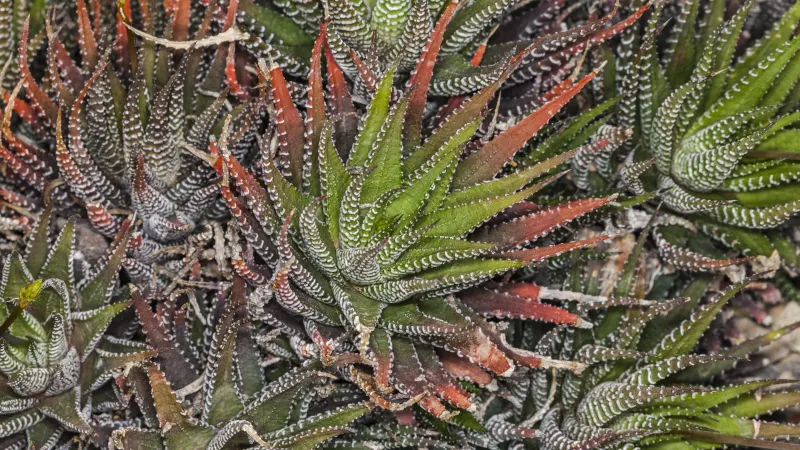
The zebra haworthia is a small, stemless succulent that forms tight, star-shaped rosettes of stiff, pointed, dark green leaves, banded with raised white bumps. Those bumps are tubercles, and they are what give the plant its other common name, zebra plant. NC State Extension describes it as a slow-growing, clumping perennial that can spread into a carpet of rosettes, and gives it a lifespan of up to 50 years. Its species name, attenuata, refers to the leaves tapering to thread-like tips.
It is native to the Cape Provinces of South Africa, where, NC State Extension notes, it often grows partly buried in sand. The RHS describes a rosette to about 12 cm tall, and NC State gives a range of 10–30 cm in height as the clumps mature. From late spring into summer it sends up long, wiry stalks, up to 40 cm long according to the RHS, carrying small tubular flowers, white to pale pink. The flowers are modest; the leaves are the point of the plant.
Haworthias have a long history indoors. University of Wisconsin Extension notes that they have been cultivated in Europe for nearly 400 years, and that the genus is named after Adrian Hardy Haworth (1768–1833), a British botanist and entomologist. Haworthias were once considered part of Aloe, the genus of aloe vera, then placed in the lily family, and are now in Asphodelaceae.
Why it is now called Haworthiopsis
If your label says Haworthia attenuata, it is not wrong, only out of date. The RHS now lists the plant as Haworthiopsis attenuata and marks Haworthia attenuata as a synonym, along with the older Aloe attenuata. NC State Extension uses the same new name and notes that Haworthiopsis was previously part of Haworthia. The plant has not changed, only the genus it is filed under.
The more practical confusion is with Haworthiopsis fasciata, which is sold under the same common names. NC State Extension gives the way to tell them apart: H. fasciata has a smooth upper leaf surface, while H. attenuata is bumpy all over. The RHS describes the zebra haworthia's white tubercles as bands across the outer face of the leaf and scattered on the upper face. Run a finger over the inside of a leaf. If it feels rough, it is attenuata; if it is smooth, it is fasciata.
Light: bright, but not a desert
A zebra haworthia does not need a desert's sun. University of Wisconsin Extension notes that many haworthias tolerate partial shade, though few look their best without some direct sun or bright light, and NC State Extension says the zebra haworthia prefers bright indirect light, which gives the best leaf colour, and tolerates low light. The RHS asks for full light, shaded from hot sun.
In practice, Wisconsin suggests an east or west window with a few hours of direct sun, and a sheer curtain on a south-facing one. Both extremes show on the leaves. In too little light, Wisconsin says, the leaves elongate and the colours fade; NC State warns that direct sun can scorch them. A plant moved outdoors for the summer after a winter indoors needs to get used to the brighter light gradually, or it burns. Haworthias also grow under plant lights, Wisconsin adds, which is useful in a room with no good window. The succulents comparison sets it beside aloe, jade and echeveria, by light, water and pet safety.
If you use Botanical Legacy, the place you put a Specimen in carries the light you described for it, as a level or as the window's direction. When a plant's light needs and its place don't match, the app flags it and names a better place you already have. It cannot measure the light at the window, so watching the leaves is still your job.
How to water a zebra haworthia
A zebra haworthia stores water in its leaves, so it is built for the dry spells between rains, not for compost that stays damp. NC State Extension's advice is to avoid overwatering and let the soil dry out between waterings. University of Wisconsin Extension suggests watering about weekly in summer, less in winter, and letting the mix dry between waterings. The RHS asks for moderate watering while it grows and an almost dry pot in winter.
The pattern is a thorough drink, then a wait. Water until it drains from the hole, empty the saucer, and do not water again until the compost has dried. Wisconsin's root rot warning is specific: prolonged wet soil does the damage, especially when it is cool, in low light, or when the plant is not actively growing. A haworthia in a cool, dim winter room can go a long time between drinks.
Wisconsin also notes that haworthias do not all grow at the same time of year: species from winter-rainfall regions grow in winter, those from summer-rainfall regions in summer, and many put on growth from late winter through spring as the days lengthen. That is a reason to water by the compost, not the calendar. The longer method is in when to water your houseplants, and the signs of each mistake are in overwatering vs underwatering.
A model of the individual plant helps here. Botanical Legacy keeps a Digital Shadow of each Specimen in your Sanctuary, a running estimate of when that particular pot will be dry. On every plan, including the free one, you can log a quick soil check from the Specimen's page, from bone dry to wet. After three checks between waterings, the model starts correcting its drying rate for that plant from what you found. For a small succulent in a small pot, whose real risk is watering too soon, that means a timing fitted to this pot in this room.
Soil, pots and repotting
The compost matters as much as the watering can. The RHS recommends cactus compost, and NC State Extension a well-draining cactus or succulent mix. University of Wisconsin Extension gives a recipe: potting mix improved with an equal amount of perlite, aquarium gravel, poultry grit or horticultural pumice. It advises against sand, which can clog the pores in the mix, and notes that peat-based mixes break down over time.
Any container works, Wisconsin says, but terracotta dries faster than glazed ceramic or plastic, shallow pots generally suit haworthias better than deep ones, and the pot must have a drainage hole, with standing water emptied from the saucer. Repot every two to three years, into a pot about the same volume as the root system. Because haworthias offset readily, Wisconsin advises repotting as the clump grows rather than starting it in an oversized pot.
Temperature, humidity and feeding
NC State Extension says the zebra haworthia thrives at 16–27°C (60–80°F) and advises avoiding temperatures below 10°C and cold draughts. It can take a brief chill but is not frost-tolerant. The RHS rates it H2: it tolerates low temperatures of about 1–5°C, but not being frozen. University of Wisconsin Extension notes that haworthias tolerate the low 40s°F (about 5°C), especially when the compost is dry, and survive great heat if they are shaded and the air moves. The practical rule indoors is to keep it above 10°C, and the cooler the room, the drier the compost.
Humidity is not something to add. The RHS asks for low humidity with good ventilation, and NC State notes that it tolerates typical household humidity, so there is no need to mist it or stand it on a pebble tray.
Feed lightly. The RHS suggests a half-strength, low-nitrogen fertiliser once or twice while it is growing. It is a slow plant by nature, and NC State lists its growth rate as slow; more feed does not make it a fast one.
Propagation: dividing the pups
The easiest way to make more zebra haworthias is to separate the pups. NC State Extension notes that it produces pups and offsets that can be separated from the parent, and University of Wisconsin Extension says most haworthias offset readily from the base. Separate them with some root attached, and let the wounds air-heal for a few days before potting, as Wisconsin advises. The RHS gives spring and summer for separating offsets and taking leaf cuttings.
Leaf cuttings are possible too, though Wisconsin notes the method is used mainly for species that rarely offset, and mostly by professional growers. Seed is the slowest route: the RHS suggests sowing in spring at 21–24°C, and Wisconsin says germination takes about one to two weeks in a moist, well-drained mix. For the general methods, see how to propagate plants.
Common problems
Soft, shrivelled or collapsing rosettes. The first suspect is root rot. University of Wisconsin Extension names it as the main disease problem of haworthias, from poor drainage or overwatering, and says it can spread into the stem and kill the plant. Its signs include stalled growth, smaller plants or leaves, and leaves that shrivel. Because shrivelling is on that list, check the compost before you reach for the watering can: if it is damp, look at the roots. Wisconsin's treatment is to unpot it, remove weak or decayed roots, let the plant dry for about a week, then repot in fresh soil and water carefully.
Pale, stretched leaves. Too little light. Wisconsin notes that insufficient light makes the leaves elongate and the colours fade. Move it to a brighter window, out of hot midday sun.
Brown, scorched patches. Too much direct sun, especially after a move. NC State Extension notes that direct sun can scorch the leaves. Shade it, and bring a plant into brighter light gradually.
Spots on the leaves. NC State Extension warns that leaf spot and fungal disease can develop when the soil stays wet or water sits on the leaves. Water the compost, not the rosette, and let the pot dry between waterings.
White, cottony insects. Mealybugs. Wisconsin says haworthias are mostly pest-free but mealybugs can be a problem, and the RHS lists them too; NC State also mentions scale. Remove them by hand or use a houseplant insecticide according to its label, as Wisconsin advises. A photo to the Doctor, powered by Botanical Vision v5, returns a health verdict, the likely cause of what it sees, and what to do. The guide to common houseplant pests shows how to tell mealybugs from the rest.
Frequently asked questions
How often should I water a zebra haworthia?
When the compost has dried out, not on a fixed day. University of Wisconsin Extension suggests about weekly in summer and less in winter, letting the mix dry between waterings, and the RHS says to keep it almost dry in winter. In a cool or dim room it needs less still, because wet compost in cool, low-light conditions is what rots the roots.
Can a zebra haworthia grow without direct sun?
Yes, within limits. NC State Extension says it prefers bright indirect light and tolerates low light, and University of Wisconsin Extension notes that many haworthias tolerate partial shade. It keeps its best colour with some bright light or a few hours of gentle sun. In a dark spot the leaves stretch and fade, and a plant light is an option.
What is the difference between Haworthia attenuata and Haworthia fasciata?
The texture of the leaves. NC State Extension notes that Haworthiopsis fasciata has a smooth upper leaf surface, while Haworthiopsis attenuata is bumpy all over. Both are sold as zebra plant or zebra haworthia, and both have moved to the genus Haworthiopsis, which the RHS and NC State use.
Why is my haworthia turning soft or shrivelling?
Check the compost first. Damp compost and soft leaves point to root rot, which University of Wisconsin Extension names as the main disease of haworthias; unpot it, cut away decayed roots, let it dry for about a week and repot in fresh, gritty mix. Wisconsin lists stalled growth and smaller leaves among the same signs, so a plant that has stopped growing in damp compost deserves the same check.
Is zebra haworthia toxic to cats and dogs?
No. The ASPCA lists zebra haworthia as non-toxic to dogs, cats and horses, and NC State Extension lists Haworthiopsis attenuata as non-toxic to pets and people. The ASPCA files that entry under the name Haworthia fasciata, the species it is so often confused with, and lists haworthias in general as non-toxic to dogs and cats. That makes it one of the succulents a pet household can keep on a low windowsill.
Can Botanical Legacy help me stop overwatering a succulent?
It helps with exactly that. A zebra haworthia's real risk is a drink given before the pot has dried, and how fast a small pot dries depends on the window and the season. Each Specimen gets its own Digital Shadow, an estimate of when its pot will be dry, and soil checks you log on any plan teach the model that plant's real drying rate. Progress photos build growth curves of height and leaf count, so a slow plant's new leaves show up as a trend instead of a guess.
Start your sanctuary
Botanical Legacy's free Observer plan covers up to five Specimens, each with its own continuously running Digital Shadow and soil checks that teach it each pot's drying rate. A zebra haworthia, small, slow and easily killed by a watering given too soon, is exactly the kind of plant a steady per-pot model is for. Every new account also includes a 14-day trial of Cultivator, the paid plan, which adds the local weather feed and soil sensor support.
START YOUR SANCTUARY - FIVE FREE SPECIMENS, NO PAYMENT REQUIRED →
Give a zebra haworthia bright light, a gritty pot and long dry spells, and it will keep its stripes for decades.
Sources
6 references
The plant-care facts on this page were checked against these references.
- NC State Extension: plants.ces.ncsu.edu/plants/haworthiopsis-attenuata
- RHS: rhs.org.uk/plants/504241/haworthiopsis-attenuata/details
- RHS: rhs.org.uk/plants/8268/haworthia-attenuata/details
- University of Wisconsin Extension: hort.extension.wisc.edu/articles/haworthia
- ASPCA: aspca.org/pet-care/aspca-poison-control/toxic-and-non-toxic-pla…
- ASPCA: aspca.org/pet-care/aspca-poison-control/toxic-and-non-toxic-pla…