Species care guide
Echeveria
Echeveria spp.
How to care for an echeveria indoors: the light that keeps the rosette tight and coloured, how to water a succulent that rots in cold, wet compost, why it stretches in winter, how to tell Echeveria elegans from E. agavoides, and how to grow new plants from offsets and leaves.

- Light
- As bright as you have: a sunny windowsill, south- or west-facing; in too little light the rosette stretches and the colour fades
- Water
- When the compost is approaching dry; water thoroughly, never leave it standing in water, and give only a little every few weeks in winter
- Humidity
- Nothing to add; keep it out of cold, wet conditions and away from radiators during its winter rest
- Temperature
- Keep it above 10°C indoors, with cool winter nights of about 8–10°C; not frost hardy, so bring it in well before the first frost
- Pets & toxicity
- Non-toxic to cats, dogs and horses, a pet-safe succulent
- Difficulty
- Easy in a sunny window; it stretches in poor light or a warm, wet winter, and most losses are compost kept too wet
An echeveria does not lose its shape from neglect. It loses it in a warm room with too little light and too much water, and a cool, dry winter is what keeps the rosette tight.
What an echeveria is
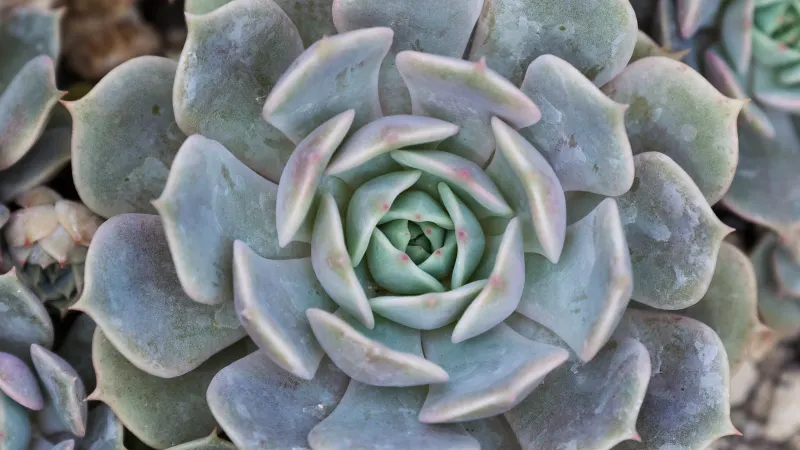
An echeveria is a succulent that grows as a rosette: thick, fleshy leaves packed in a spiral, close to the ground. NC State Extension counts nearly 200 species in the genus, along with a great many hybrids, and gives the usual leaf colours as grey, sea green and blue-green, with plenty of variations; the RHS adds greyish-pink, and notes that mature plants produce offsets that build into an ever-widening clump. It belongs to Crassulaceae, the stonecrop family, which NC State notes also includes the sedums, the jade plant and kalanchoe.
The genus is native to the Americas, from southwest Texas to northwest Argentina, according to NC State Extension, and is named after Atanasio Echeverría y Godoy, a botanical illustrator who contributed to the Flora Mexicana. Most echeverias stay small. NC State gives the genus a range of about 2.5–30 cm in height and 5–30 cm in spread, and calls the growth rate slow.
Once a year a flower stalk rises above the rosette, carrying tubular flowers that NC State describes as usually light or deep pink, from spring into summer. Over time the shape changes on its own: NC State notes that the lower leaves eventually wither and drop and the stem becomes visible. That is ageing, not a fault, and the section on propagation explains what to do with a rosette that has grown a long neck.
The two you are most likely to have
Echeveria elegans, the Mexican snow ball, also sold as Mexican gem or white Mexican rose. The RHS describes a clump of rosettes of spoon-shaped, whitish-green leaves, to about 10 cm tall, with one-sided stalks of lantern-shaped pink flowers tipped with yellow in late winter and spring. NC State Extension gives its native range as northeastern Mexico, describes the leaves as pale green-blue or silvery-green and up to about 6 cm long, and lists its 5–7 flowers to a stalk. It holds the RHS Award of Garden Merit. Its offsets, which NC State calls pups, are why one plant becomes a pot full.
Echeveria agavoides, the moulded wax succulent. The RHS describes triangular-ovate, pale green leaves with red margins, and lantern-shaped red flowers with yellow tips on stalks up to 40 cm tall, in spring and summer. It is from Mexico, it also holds the Award of Garden Merit, and the RHS gives it 5–10 years to reach full size, against 2–5 years for E. elegans. Pointed, red-edged leaves tell it apart from the rounder, paler elegans at a glance.
The RHS's advice for the two is close: gritty compost, moderate watering while they grow, and a dry or almost dry winter. The care below applies to both.
Light: as bright as you have
Echeverias are sun plants. NC State Extension notes that they are tolerant of full sun and that leaf colour improves with more sunlight, and the RHS entries for both E. elegans and E. agavoides give full sun, with elegans suited to a south- or west-facing aspect. The RHS's general guide to succulent houseplants asks for a sunny windowsill all year round.
The sources differ in degree, not direction. The RHS's echeveria page says they prefer bright but indirect light, and its growing advice for E. agavoides under glass asks for bright, filtered light. None of them suggests a dim corner, and indoors the practical reading is the brightest window in the house.
What poor light does is easy to see. University of Illinois Extension notes that succulents without enough light begin to stretch and elongate, and colourful ones revert to green; it suggests about six hours a day of bright light and turning the plant each week so every side gets its share. The RHS lists weak, misshapen growth among the signs of too little light. A rosette whose leaves have spread apart and turned upwards towards the window is asking for more of it. The succulents comparison sets it beside aloe, jade and haworthia, by light, water and pet safety.
If you use Botanical Legacy, the place you put a Specimen in carries the light you described for it, as a level or as the window's direction. When a plant's light needs and its place don't match, the app flags it and names a better place you already have. It cannot measure the light at the window, so watching the rosette is still your job.
How to water an echeveria
An echeveria keeps its water in its leaves, and NC State Extension says it needs little water and is drought tolerant. The RHS's advice is to water modestly, once the compost is approaching dryness and only when it starts to feel dry, and never to leave the plant sitting in water. For E. elegans, NC State names overwatering as the most common problem.
The pattern is a thorough drink, then a wait. The RHS's succulent guide says to water thoroughly in spring and summer once the surface of the compost feels dry, and let the excess drain away. Empty the saucer, and do not water again until the compost has dried. In winter the RHS says to reduce watering, or the roots may rot.
The RHS suggests rainwater where you can, because fluoride in tap water can damage echeveria leaves. It also notes that echeverias dislike cold and wet together, which is why the same watering that is fine in July can rot a plant in January. Water by the compost, not the calendar. The longer method is in when to water your houseplants, and the signs of each mistake are in overwatering vs underwatering.
A model of the individual plant helps here. Botanical Legacy keeps a Digital Shadow of each Specimen in your Sanctuary, a running estimate of when that particular pot will be dry. On every plan, including the free one, you can log a quick soil check from the Specimen's page, from bone dry to wet. After three checks between waterings, the model starts correcting its drying rate for that plant from what you found. For a succulent in a small pot, whose real risk is watering too soon, that means a timing fitted to this pot in this room.
The winter rest, and why echeverias stretch
Echeverias want a winter that is cooler and drier than the rest of the year. The RHS's echeveria page asks for a cooler, drier, dormant rest over winter, watered only lightly every few weeks, enough to stop the leaves shrivelling and dropping. Its succulent guide puts that rest from November to early March, with night temperatures of 8–10°C, away from radiators. The RHS entry for E. elegans goes further, and says not to water at all while it is dormant; for E. agavoides it says to keep the plant almost dry in winter.
The reason is shape. The RHS warns that echeverias kept too warm or watered too often in winter produce weak, spindly growth, known as etiolation, which spoils their appearance. Put that beside the University of Illinois Extension warning about light, and a warm room in the short, dull days of winter is the worst place for one: warm enough to grow, too dark to grow compactly. A badly stretched plant can be beheaded and rerooted, as described below.
So the best winter spot is a bright, cool windowsill in a room you do not heat much, rather than a warm shelf away from the glass. Keep the plant above 10°C, as the RHS advises for echeverias, and keep the compost close to dry.
Soil, pots and repotting
The RHS recommends a peat-free cactus compost, gritty and sharply draining, in a pot with plenty of drainage holes; its succulent guide gives a home mix of two parts peat-free John Innes No 2 to one part grit or sharp sand, topped with grit. NC State Extension asks for very well-drained soil and suggests shallow containers for E. elegans, and University of Illinois Extension calls unglazed terracotta a good choice. Size the pot to the plant. The RHS advises repotting in spring, when the roots have filled the pot or the plant has outgrown it, and warns against oversized pots, because the extra compost stays wet and can cause rot.
Temperature, humidity and feeding
The RHS rates both E. elegans and E. agavoides H2: they tolerate low temperatures of about 1–5°C but do not survive being frozen. NC State Extension says echeverias are not truly frost hardy and must come indoors for winter outside frost-free areas. For a plant indoors, the RHS's line is to keep it above 10°C.
Echeverias can spend the summer outside. The RHS notes that they can be grown outdoors in summer, in borders, containers and hanging baskets, and suggests standing E. agavoides outside for the summer months; bring them back indoors well before the first frost.
Nothing in the RHS or NC State advice calls for misting or extra humidity. The RHS's warnings are about cold, wet compost, and about keeping the plant away from radiators during its winter rest, so give it light, not a pebble tray.
Feed lightly. For E. elegans the RHS suggests a balanced liquid fertiliser two or three times in the growing season; for E. agavoides it gives a balanced feed every two or three weeks while growing. Its general succulent guide gives monthly feeding from April to September with a high-potassium feed, such as a tomato fertiliser or a cactus feed. Stop when the winter rest begins.
Propagation: offsets, leaves and a long neck
Echeverias are among the easiest succulents to multiply. The RHS's guide to leaf cuttings names Echeveria among the succulents propagated from leaves, and NC State Extension lists offsets, crown cuttings and leaf cuttings.
Offsets. NC State notes that the small rosettes around the base of the mother plant can be detached and planted in very well-drained soil, where they root. The RHS suggests separating offsets in spring, once they are well rooted.
Leaves. Choose a healthy, young, fully grown leaf. The RHS's method is to leave the leaf a day or two to callus, then set it on pots of two parts cactus compost to one part fine grit, topped with grit and not covered, in a warm, light spot. Keep the compost only slightly moist, because wet compost rots the cuttings; the RHS suggests about 20°C and spring to early summer for the best results. NC State describes what follows: a small rosette forms at the base of the leaf, and the old leaf withers.
A long neck. An echeveria that has lost its lower leaves and stands on a bare stem can be beheaded. NC State Extension suggests cutting off the top tuft with about 2.5 cm of stem and repotting it. The RHS's advice for succulent stem cuttings is to let the cut end callus for a day to a week, then insert it in gritty compost kept slightly moist. For the general methods, see how to propagate plants.
Common problems
Soft or collapsing leaves. Too much water, especially in a cool room. The RHS lists root damage, stunted growth, blistering (oedema) and rot among the signs of overwatering, and warns that without reduced watering in winter the roots may rot. Let the compost dry out before the next watering.
Stretched, pale rosettes. Too little light, or a winter that is too warm and too wet. The RHS names both: weak, misshapen growth in poor light, and etiolation when kept too warm or watered too often in winter. Move it to a brighter, cooler window and water less.
Shrivelled, wrinkled leaves. The RHS lists shrivelling and slow or misshapen growth as signs of underwatering. In winter a little shrivelling is why the RHS suggests light watering every few weeks; check that the compost is dry before you give more.
Rotting lower leaves. NC State Extension advises removing withered lower leaves, because they can be a source of disease. Pull dead leaves away from the base and keep the rosette clean.
White, cottony insects. Mealybugs. The RHS and NC State Extension both list mealybugs, aphids and vine weevils for E. elegans, and the RHS gives the same three for E. agavoides; its succulent guide adds red spider mites and scale insects. A photo to the Doctor, powered by Botanical Vision v5, returns a health verdict, the likely cause of what it sees, and what to do. The guide to common houseplant pests shows how to tell mealybugs from the rest.
Frequently asked questions
How often should I water an echeveria?
When the compost is approaching dry, not on a fixed day. The RHS says to water modestly once the compost starts to feel dry and never to leave the plant standing in water, and University of Illinois Extension suggests letting the soil dry out completely between waterings. In winter, the RHS's advice is a light watering every few weeks, only enough to stop the leaves shrivelling.
Why is my echeveria stretching?
Too little light, a winter that is too warm and wet, or both. University of Illinois Extension notes that succulents without enough light stretch and lose their colour, and the RHS warns that echeverias kept too warm or watered too often in winter produce weak, spindly growth. Give it the brightest window you have and a cool, dry winter. A badly stretched plant can be cut back to its rosette and rerooted.
Does an echeveria need direct sun?
It grows best with it. NC State Extension says echeverias tolerate full sun and colour up with more of it, and the RHS gives full sun for both E. elegans and E. agavoides. Its echeveria page asks for bright but indirect light, so the sources agree on bright and differ only on how much direct sun; the brightest window you have satisfies both.
What is the difference between Echeveria elegans and Echeveria agavoides?
The leaves. The RHS describes E. elegans as spoon-shaped and whitish-green, in clumps of rosettes to about 10 cm, and E. agavoides as triangular-ovate and pale green with red margins. E. elegans flowers pink with yellow tips in late winter and spring; E. agavoides flowers red with yellow tips in spring and summer.
Is echeveria toxic to cats and dogs?
No. The ASPCA lists Echeveria elegans (under the name hens and chickens) as non-toxic to dogs, cats and horses, and lists an unnamed Echeveria species, the variegated wax plant, as non-toxic to dogs and cats. NC State Extension lists the genus as non-toxic to cats, dogs and horses. The ASPCA notes that some pets may still get a mild upset stomach from eating any plant.
Can Botanical Legacy help me keep an echeveria from rotting?
It helps with the timing. An echeveria's real risk is a drink given before the pot has dried, and how fast a small pot dries depends on the window and the season. Each Specimen gets its own Digital Shadow, an estimate of when its pot will be dry, and soil checks you log on any plan teach the model that plant's real drying rate. Progress photos build growth curves of height and leaf count, so a slow plant's new leaves show up as a trend instead of a guess.
Start your sanctuary
Botanical Legacy's free Observer plan covers up to five Specimens, each with its own continuously running Digital Shadow and soil checks that teach it each pot's drying rate. An echeveria, which needs a drink in summer and almost none in winter, is exactly the kind of plant a steady per-pot model is for. Every new account also includes a 14-day trial of Cultivator, the paid plan, which adds the local weather feed and soil sensor support.
START YOUR SANCTUARY - FIVE FREE SPECIMENS, NO PAYMENT REQUIRED →
Give an echeveria a sunny window and a cool, dry winter, and it keeps the tight rosette it was bought for.
Sources
11 references
The plant-care facts on this page were checked against these references.
- NC State Extension: plants.ces.ncsu.edu/plants/echeveria
- RHS: rhs.org.uk/plants/echeveria
- RHS: rhs.org.uk/plants/6226/echeveria-elegans/details
- NC State Extension: plants.ces.ncsu.edu/plants/echeveria-elegans
- RHS: rhs.org.uk/plants/6220/echeveria-agavoides/details
- RHS: rhs.org.uk/plants/types/cacti-succulents/houseplants/growing-gu…
- University of Illinois Extension: extension.illinois.edu/blogs/good-growing/2017-12-13-stepping-w…
- RHS: rhs.org.uk/propagation/leaf-cuttings
- ASPCA: aspca.org/pet-care/aspca-poison-control/toxic-and-non-toxic-pla…
- ASPCA: aspca.org/pet-care/aspca-poison-control/toxic-and-non-toxic-pla…
- ASPCA: aspca.org/news/are-succulents-safe-have-around-pets