Plant care · 14 min read
Succulents compared - which one suits your window, your watering and your pets
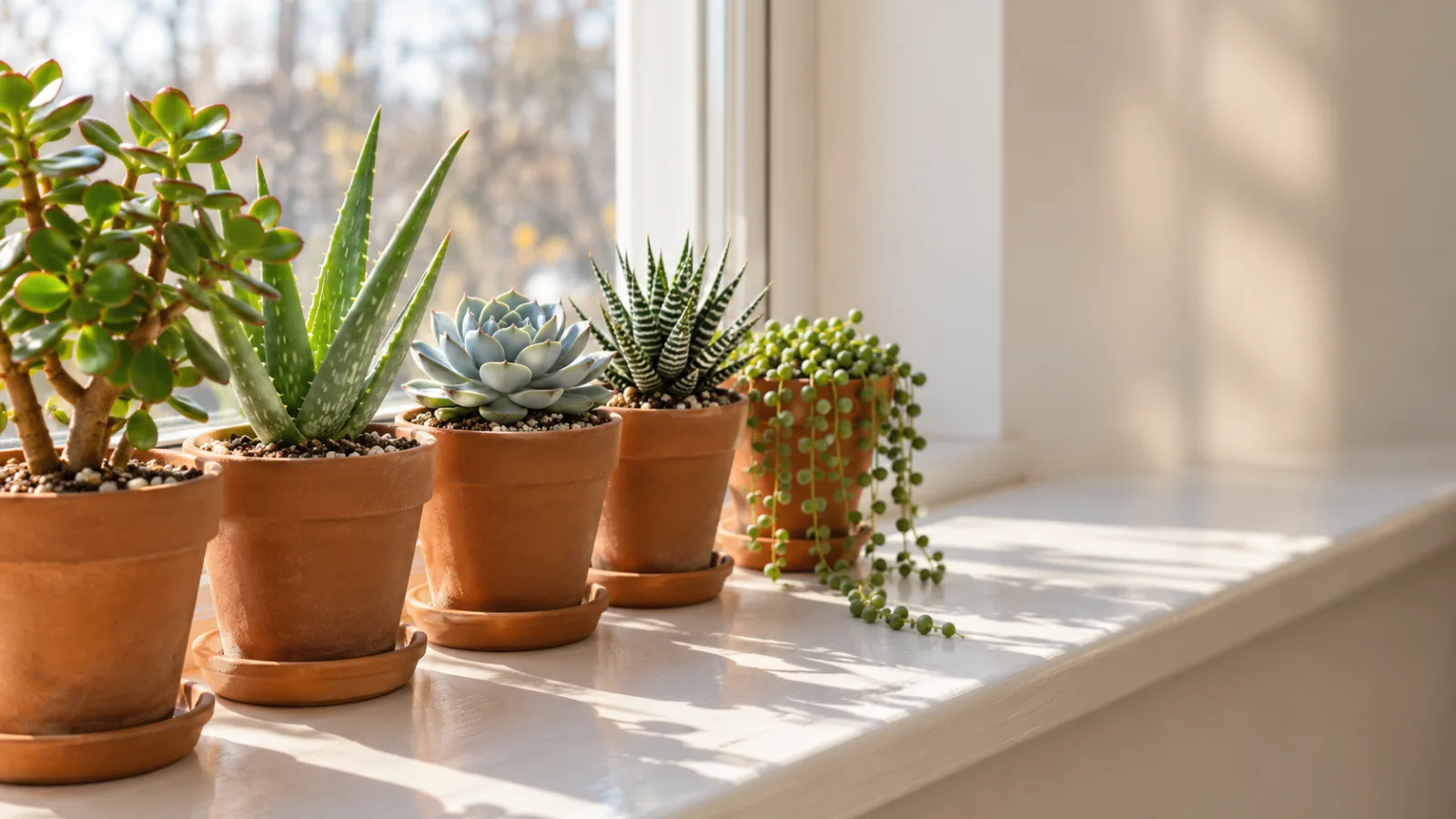
Nine common indoor succulents side by side: how much light each one needs, how to water it, the coldest it will take, how to propagate it and whether it is safe for cats and dogs. Choose by the window you have, not the plant you like the look of.
Botanical Legacy · Field notes ·
A succulent is not a plant that needs no care. It is a plant built for a brighter window than most homes have.
Succulents are a strategy, not a care level
"Succulent" describes how a plant survives drought, not how easy it is to keep. Succulents have fleshy stems and leaves that store water, and many of them use a form of photosynthesis called CAM, opening their pores to take in carbon dioxide at night, when the air is cooler and less water escapes. Research on CAM plants puts their water-use efficiency at several times that of ordinary plants. That is a superb design for a dry, sunny hillside. It does not make a succulent a good plant for a dim corner.
Light is where most indoor succulents struggle. Iowa State Extension says most succulents need at least six to eight hours of bright light a day indoors, ideally ten or more, and UF/IFAS describes succulents as needing more than four hours of direct light. A succulent short of light stretches: new growth comes in tall, pale and spindly, and rosettes open out and flatten as the plant reaches for more.
The other way they fail is water, and the two problems feed each other: Penn State Extension links root rot in haworthias to prolonged wet compost combined with low light. Ordinary potting compost already holds more water than succulents like, and in waterlogged compost the roots run short of oxygen and die. The RHS lists overwatering as the cause of stunted growth, blistering and rot, and calls winter wet the main killer of succulents grown outdoors.
So compare succulents by four questions: how much light each one needs, how dry it wants to get, how much cold it will take, and whether it is safe in a home with pets. Those four answers decide which plant suits which window.
Nine indoor succulents compared
| Succulent | Light indoors | Watering | Coldest it takes | Cats and dogs (ASPCA) | Propagate from |
|---|---|---|---|---|---|
| Jade plant (Crassula ovata) | Four or more hours of direct sun; survives bright indirect light | Let it dry between waterings; restrict in winter | Light frost, but freezing kills it | Toxic | Stem or leaf cuttings |
| Aloe vera | Full sun; adapts to some part shade | Moderately in growth, very sparingly in winter | 5–10°C | Toxic | Offsets |
| Echeveria | Full sun to bright light | When the compost is nearly dry; less in winter | Keep above 10°C | Non-toxic | Offsets, leaves, crown cuttings |
| Haworthia, zebra plant | Bright indirect light; copes with lower light | Sparingly, when nearly dry | Keep above 10°C | Non-toxic (zebra haworthia) | Offsets |
| String of pearls (Curio rowleyanus) | Bright indirect, out of midday sun | Sparingly in winter, without letting the pearls shrivel | Keep above about 10°C | Stomach upset, vomiting, lethargy | Stem cuttings |
| Burro's tail (Sedum morganianum) | Full sun to bright, filtered light | Let it dry between waterings; sparingly in winter | 5–10°C | Non-toxic | Leaf or stem cuttings |
| Panda plant (Kalanchoe tomentosa) | Bright light, ideally six hours or more | Let it dry between waterings; sparingly in winter | 10–15°C | Toxic | Leaf cuttings, offsets |
| Snake plant (Dracaena trifasciata) | Tolerates very low light; grows better in brighter light | Do not overwater; in winter, every one to two months | Keep above 10°C | Toxic | Division, leaf cuttings |
| Christmas cactus (Schlumbergera) | Indirect or filtered light | Keep moist, never waterlogged, in growth; do not let it dry out completely | Keep above 10°C | Non-toxic | Stem segments |
Temperatures are from RHS hardiness ratings and growing guides, and toxicity from the ASPCA's plant lists. The notes below cover what the table cannot.
Jade plant
A succulent from the dry, rocky hillsides of South Africa. Clemson Extension wants four or more hours of direct sun a day for it. University of Wisconsin Extension says it will survive in bright, indirect light, but grows deep green with drooping stems there. Grown in strong sun, its leaves can pick up red tints. It takes a light frost, but freezing kills it, and overwatering drops its leaves and rots the stem. It roots easily from a stem or a single leaf. Full guide: jade plant care.
Aloe vera
Native to the Arabian Peninsula, and a sun plant: the RHS gives it full sun, ideally from a south- or west-facing window, and Missouri Botanical Garden says it adapts to some part shade. The gel in its leaves is widely used to soothe minor burns, but Missouri Botanical Garden warns the sap should not be eaten, and the ASPCA lists the plant as toxic to cats and dogs. It makes offsets at the base, which you can pot up separately in spring. UF/IFAS warns that an aloe moved from low light to bright light too quickly can sunburn. Full guide: aloe vera care.
Echeveria
Rosette-forming succulents from the Americas, ranging from southwest Texas to northwest Argentina. NC State Extension says they tolerate full sun and their leaf colour improves with it, and the RHS suggests bright light indoors. Short of light, the rosette opens up, the leaves flatten and the stem stretches. UF/IFAS warns not to let water sit in the centre of the rosette. The ASPCA lists echeverias as non-toxic, and they propagate from a single leaf laid on compost.
Haworthia and zebra plant
Small South African succulents, many now classed in the related genus Haworthiopsis, including the striped zebra plant. They are the succulents for a less sunny room. University of Wisconsin Extension calls them well adapted to the lower light in homes, and NC State says they tolerate low light, though they do best in bright, filtered sun and their colour fades in weak light. Keep them above 10°C. Penn State Extension warns that prolonged wet compost in low light causes root rot. The ASPCA lists zebra haworthia as non-toxic.
String of pearls
A trailing succulent from the dry parts of South Africa, now Curio rowleyanus (formerly Senecio). Each pearl is a water-storing leaf with a translucent window on its surface. It wants bright, indirect light: the RHS suggests near an east- or west-facing window, out of midday summer sun, which scorches it. In winter, water sparingly, but not so little that the pearls shrivel. Missouri Botanical Garden notes that shrivelled pearls can come from too much water, too little, or the wrong light, so check the compost before deciding. The ASPCA says it can cause stomach upset, mainly vomiting, and lethargy in pets. Full guide: string of pearls care.
Burro's tail
A trailing Mexican sedum with long ropes of plump leaves. It wants high light, a windowsill with at least partial sun, and the soil allowed to dry between waterings. Its one quirk is fragility: NC State Extension notes that the leaves break off if handled. The fallen leaves root easily, so a clumsy repot gives you a tray of new plants. The ASPCA lists it as non-toxic.
Panda plant
A fuzzy-leaved Kalanchoe from Madagascar, with brown-tipped, felted leaves. It wants bright light, ideally six hours or more, and is not cold hardy: the RHS rates it to 10–15°C. Like all kalanchoes, it is toxic to cats and dogs: the ASPCA lists vomiting and diarrhoea, and rarely an abnormal heart rhythm. Its flowering relative, flaming Katy (Kalanchoe blossfeldiana), only reblooms after about six weeks of fourteen-hour nights. Full guide: kalanchoe care.
Snake plant
The odd one out: a succulent-leaved plant from West and West Central Africa, now classed as Dracaena trifasciata (formerly Sansevieria). It is the most shade-tolerant plant here. NC State says it can tolerate very low light, though the RHS notes it grows better in brighter spots. It still rots if overwatered, and in winter it needs little water. It is toxic to cats and dogs, and divides easily. Full guide: snake plant care.
Christmas cactus
The contrast case. A Christmas cactus is a forest cactus from southeastern Brazil, growing on rocks and in trees, and it wants almost the opposite of a desert succulent. The RHS says rainforest succulents need more frequent watering and semi-shade. Keep it moist but never waterlogged while it grows, and do not let the compost dry out completely. Flower buds form as the days shorten in autumn, and UF/IFAS says it needs at least twelve hours of darkness to set them. The ASPCA lists it as non-toxic. Full guide: Christmas cactus care.
What to do
Choose by the window, not by the plant. Put your best light first. A sunny south- or west-facing sill can carry aloe, echeveria, jade and burro's tail. A bright east-facing window suits string of pearls, Christmas cactus and haworthia. A room with no direct sun is for a snake plant or a haworthia, or for a succulent under a grow light. Iowa State Extension suggests keeping the plant within 30 cm (12 inches) of the light, on for 12–16 hours a day.
Use gritty compost and a pot with a hole. The RHS recommends a free-draining, peat-free gritty compost, with up to 30% grit or fine gravel mixed in. Iowa State Extension suggests about one-third organic material to two-thirds mineral. The pot must have a drainage hole. A layer of gravel at the bottom is not a substitute.
Soak, then let it dry. When you water, water thoroughly until it drains, then wait until the compost has dried before the next drink. Iowa State Extension is blunt: succulents will not tolerate staying wet. The Christmas cactus is the exception here, because it should never dry out completely. For the general method, see when to water your houseplants.
Give desert succulents a winter rest. The RHS suggests keeping them cool from November to early March, with nights around 8–10°C, and watering minimally or not at all. A warm room and a wet pot in winter is what produces weak, stretched growth.
Move them into brighter light gradually. A succulent that has lived in low light can scorch if it goes straight into full sun. Iowa State Extension advises changing a succulent's light slowly, and UF/IFAS gives the same warning for aloe.
Cut stretched growth back if it does not recover. Iowa State Extension notes that some plants recover in better light and others need cutting back. The RHS suggests replacing a leggy plant with cuttings. Most succulents root from offsets, stem cuttings or leaf cuttings: let the cut end dry for a day to a week, then set it in barely moist gritty compost. The guide to propagating houseplants covers the method.
Check the pet list before you buy. Jade, aloe, panda plant and snake plant are on the ASPCA's toxic list. Echeveria, zebra haworthia, burro's tail and Christmas cactus are listed as non-toxic.
Three ways this plays out
A north-facing flat
A jade plant bought for a north-facing living room puts on long gaps between pairs of leaves through its first winter, and the stems start to lean. Nothing about the watering is wrong. The plant simply has a fraction of the direct sun it wants. Swapped for a haworthia and a snake plant, the same windowsill holds two plants that stay compact. The jade goes to a brighter room, and its stretched tips are taken as cuttings. The lesson: in a dim room, choosing the right plant matters more than any amount of care.
A south-facing sill
An aloe that spent a summer in a shady corner is moved onto a sunny south-facing sill in a heatwave week and comes up with bleached, brown patches within days. The next time, it goes to the sunny window for a few hours at a time over a couple of weeks before it stays there. The same sill grows an echeveria with tight, coloured rosettes and a jade plant with red-edged leaves. The lesson: a sun-loving succulent still needs time to adjust to strong sun.
A home with a cat
A guardian with a cat that chews anything green chooses only from the non-toxic list: an echeveria, a zebra haworthia, a burro's tail on a high shelf and a Christmas cactus. The burro's tail drops leaves every time the cat brushes past, and every fallen leaf goes into a tray of gritty compost, where most of them root. The lesson: the safe list is long enough to fill a windowsill, and some of its plants are fragile in their own ways.
What Botanical Legacy does about it
It starts with the place. When you add a plant to your Sanctuary, you choose the room or outdoor spot it lives in, and that place carries the light you described: a light level, or the direction its window faces. If a Specimen's light needs and its place don't match, the Specimen's page says so and, where you have one, names a place that would suit it better. That is the north-facing jade plant problem, flagged before the stems start to lean.
Each pot gets its own drying rate. Every Specimen has a Digital Shadow, a running estimate of when its pot will be dry, so each succulent's pot is tracked on its own, not on a shared schedule. On every plan, including the free one, you can log a quick soil check from the Specimen's page, from bone dry to wet. After three checks between waterings, the model starts correcting its drying rate for that plant from what you found. A soil-moisture sensor connected through Home Assistant does the same thing continuously on the paid plan.
Photos keep the record. The identification photo, read by Botanical Vision v5, names the plant and becomes the first picture in its gallery and the starting point of its growth curves, with height and leaf count where the photo allows. When something looks wrong, a photo to the Doctor, powered by Botanical Vision v5, compares it with the previous picture and gives you a second opinion. Identification and diagnosis draw on the same monthly photo allowance.
What the model can't see
It can't measure the light on your windowsill. It works from the light you describe for each place, and a sill that looks bright to you can still be too dim for an echeveria. It can't feel the compost: its estimate is a model until a soil check or a sensor reading corrects it. It doesn't know that your succulents are on a cold windowsill in winter, or which of them your cat has started chewing. The pet list, the gradual move into sun and the scissors for stretched growth stay with you.
Frequently asked questions
Which succulent is best for low light?
A snake plant or a haworthia. NC State Extension says the snake plant can tolerate very low light, and University of Wisconsin Extension calls haworthias well adapted to the lower light in homes. Both still grow better with more light. Most other succulents, including jade, aloe and echeveria, stretch and lose colour in a room without direct sun. If you want those, add a grow light.
Which succulents are safe for cats and dogs?
On the ASPCA's lists, echeveria, zebra haworthia, burro's tail and Christmas cactus are non-toxic to cats and dogs. Jade plant, aloe vera, kalanchoes such as the panda plant, and snake plant are toxic. The ASPCA says string of pearls can cause stomach upset, vomiting and lethargy.
How often should you water succulents indoors?
There is no fixed interval. Water thoroughly until it drains, then wait until the compost has dried out before watering again. In a bright summer that comes round far more often than in winter, when desert succulents rest and the RHS suggests watering minimally or not at all. The Christmas cactus is the exception: it should never dry out completely.
Why is my succulent growing tall and thin?
It is short of light. Iowa State Extension describes tall, spindly, pale new growth and opened, flattened rosettes as a sign that light levels are too low. Move it to a brighter spot, gradually. Iowa State Extension notes that some plants recover in better light and others need cutting back, and the cuttings can be rooted into new, compact plants.
Is a Christmas cactus a succulent?
Yes, but a forest one. It comes from the rainforests of southeastern Brazil, where it grows on rocks and trees, so it wants indirect light and compost that stays lightly moist, not the full sun and dry spells a desert succulent wants. The RHS says rainforest succulents like it need more frequent watering and semi-shade.
What is the difference between a jade plant and aloe vera?
Both are sun-loving succulents that want gritty compost, a dry spell between waterings and a drier winter. The jade is from South Africa, wants four or more hours of direct sun, and propagates from stem or leaf cuttings. The aloe is a rosette from the Arabian Peninsula that spreads by offsets at its base. Both are toxic to cats and dogs.
Can Botanical Legacy tell me if my succulent is in the wrong spot?
Yes, within the limits of what you tell it. Each place in your Sanctuary carries the light you described, and if a Specimen's light needs don't match its place, the Specimen's page says so and suggests a better place where you have one. It can't measure the light itself, so the description you give each place matters.
Start your sanctuary
Botanical Legacy's free plan covers up to five Specimens, indoors or out, with continuous Digital Shadow modelling, a light check for each plant's place, and soil checks that teach each pot's drying rate. Every new account also gets a 14-day trial of the paid plan, which adds local weather and sensor support - the layer that learns how your pots dry so you don't have to guess.
Start your sanctuary - five free specimens, no payment required →
Every succulent was built for a brighter window than yours. Choose the one that was built for the window you have.
Sources
44 references
The plant-care facts on this page were checked against these references.
- UF/IFAS: gardeningsolutions.ifas.ufl.edu/plants/ornamentals/succulents
- Chen et al. 2020, Horticulture Research: academic.oup.com/hr/article/6445383
- Iowa State Extension: yardandgarden.extension.iastate.edu/how-to/growing-succulents-i…
- UF/IFAS: gardeningsolutions.ifas.ufl.edu/plants/houseplants/light-for-ho…
- Iowa State Extension: yardandgarden.extension.iastate.edu/how-to/common-problems-and-…
- RHS: rhs.org.uk/plants/types/cacti-succulents/houseplants/growing-gu…
- Penn State Extension: extension.psu.edu/zebra-plant-as-a-houseplant
- UW-Madison Extension: hort.extension.wisc.edu/articles/jade-plant-crassula-ovata
- Clemson HGIC: hgic.clemson.edu/factsheet/jade-plant
- Missouri Botanical Garden: missouribotanicalgarden.org/PlantFinder/PlantFinderDetails.aspx
- RHS: rhs.org.uk/plants/4739/crassula-ovata/details
- RHS: rhs.org.uk/plants/981/aloe-vera/details
- NC State Extension: plants.ces.ncsu.edu/plants/aloe-vera
- Missouri Botanical Garden: missouribotanicalgarden.org/PlantFinder/PlantFinderDetails.aspx
- UF/IFAS: gardeningsolutions.ifas.ufl.edu/plants/ornamentals/aloe-vera
- NC State Extension: plants.ces.ncsu.edu/plants/echeveria
- RHS: rhs.org.uk/plants/echeveria
- RHS: rhs.org.uk/plants/haworthia
- NC State Extension: plants.ces.ncsu.edu/plants/haworthiopsis-attenuata
- UW-Madison Extension: hort.extension.wisc.edu/articles/haworthias-super-succulents-fo…
- NC State Extension: plants.ces.ncsu.edu/plants/curio-rowleyanus
- RHS: rhs.org.uk/plants/string-of-beads/how-to-grow-string-of-beads
- Missouri Botanical Garden: missouribotanicalgarden.org/PlantFinder/PlantFinderDetails.aspx
- NC State Extension: plants.ces.ncsu.edu/plants/sedum-morganianum
- RHS: rhs.org.uk/plants/16969/sedum-morganianum/details
- NC State Extension: plants.ces.ncsu.edu/plants/kalanchoe-tomentosa
- RHS: rhs.org.uk/plants/9701/kalanchoe-tomentosa/details
- NC State Extension: plants.ces.ncsu.edu/plants/kalanchoe-blossfeldiana
- Missouri Botanical Garden: missouribotanicalgarden.org/PlantFinder/PlantFinderDetails.aspx
- NC State Extension: plants.ces.ncsu.edu/plants/dracaena-trifasciata
- Penn State Extension: extension.psu.edu/snake-plant-a-forgiving-low-maintenance-house…
- RHS: rhs.org.uk/plants/sansevieria
- Missouri Botanical Garden: missouribotanicalgarden.org/PlantFinder/PlantFinderDetails.aspx
- RHS: rhs.org.uk/plants/christmas-cactus/how-to-grow
- UF/IFAS: gardeningsolutions.ifas.ufl.edu/plants/houseplants/christmas-ca…
- ASPCA: aspca.org/pet-care/animal-poison-control/toxic-and-non-toxic-pl…
- ASPCA: aspca.org/pet-care/animal-poison-control/toxic-and-non-toxic-pl…
- ASPCA: aspca.org/pet-care/animal-poison-control/toxic-and-non-toxic-pl…
- ASPCA: aspca.org/pet-care/animal-poison-control/toxic-and-non-toxic-pl…
- ASPCA: aspca.org/pet-care/animal-poison-control/toxic-and-non-toxic-pl…
- ASPCA: aspca.org/pet-care/animal-poison-control/toxic-and-non-toxic-pl…
- ASPCA: aspca.org/pet-care/animal-poison-control/toxic-and-non-toxic-pl…
- ASPCA: aspca.org/pet-care/animal-poison-control/toxic-and-non-toxic-pl…
- ASPCA: aspca.org/news/are-succulents-safe-have-around-pets