Species care guide
Burro's tail
Sedum morganianum
How to care for a burro's tail indoors: the bright light that keeps the stems tightly braided, how to water a succulent that rots in wet compost, why its leaves fall off, how to tell it from 'Burrito', and how to root the leaves and stems it drops.

- Light
- Bright light to full sun, such as a sunny windowsill; in too little light the stems stretch and the leaves grow sparse
- Water
- When the compost has nearly dried out; thoroughly while it grows, less from autumn, and in winter only enough to stop the compost drying completely
- Humidity
- Nothing to add; its problems come from water at the roots, so give it a free-draining pot and airy conditions
- Temperature
- Keep it above about 10°C indoors; it can summer outdoors once nights stay above about 4°C, and a cool winter of 10–20°C may help it flower
- Pets & toxicity
- Non-toxic to cats, dogs and horses, a pet-safe trailing succulent
- Difficulty
- Easy in a sunny window; it rots in wet compost, and the leaves fall off at a touch, so handle it as little as you can
A burro's tail sheds its leaves when you touch it and grows new plants from the ones it drops. Hang it where nobody brushes past, and let the pot dry out.
What a burro's tail is
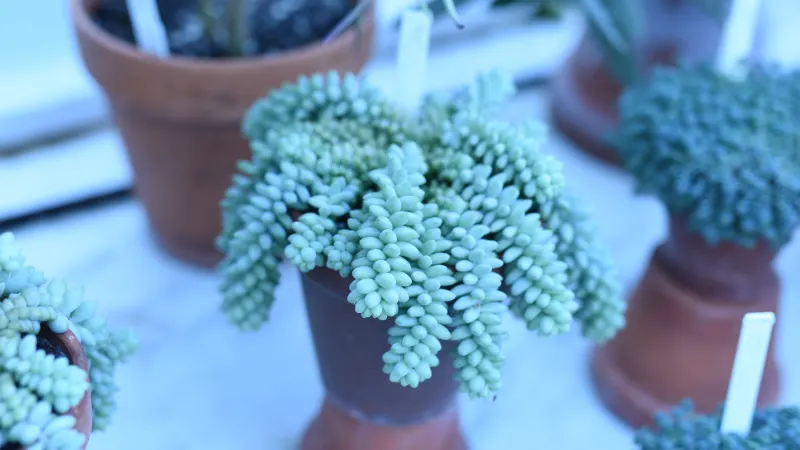
A burro's tail is a trailing succulent whose stems are covered in short, plump, overlapping leaves, packed so tightly that each stem looks braided. University of Wisconsin Extension describes the leaves as thick, cylindrical and pointed, arranged in a close, nearly spiral whorl, and blue-green with a silvery bloom that rubs off when it is handled. The stems grow upright at first, then hang, and can reach about 1.2 m long. They are heavy, Wisconsin notes, because the leaves are full of stored water.
It is a sedum, one of the stonecrops, in the family Crassulaceae. The RHS and the ASPCA list the same set of common names: burro's tail, donkey's tail, horse's tail and lamb's tail. Wisconsin points out that donkey's tail is also used for a hardy spurge, Euphorbia myrsinites, a different plant, so the botanical name is the safer label. The RHS gives its range as Mexico, and NC State Extension lists the Mexican states of Veracruz, Puebla and Chiapas.
It is a long-lived plant. Wisconsin describes it as a tender, trailing sub-shrub that can last for decades indoors, and notes that it received the RHS Award of Garden Merit in 1993. Because it is hardy only where temperatures stay well above freezing, it is grown mostly as a houseplant, in hanging baskets, urns or pots on a pedestal, wherever the stems can cascade.
Flowers are a bonus, not the point. The RHS describes clusters of small, starry, pale pink to reddish-purple flowers in spring and summer. Wisconsin says plants rarely bloom indoors, and that a stem has to reach at least about 25 cm before it flowers.
Burro's tail or 'Burrito'
The plant often sold alongside it is 'Burrito', or baby burro's tail. University of Wisconsin Extension describes it as having smaller, rounder, lime-green leaves on shorter stems, and says it is unclear whether it is a separate species, a cultivar or a hybrid. The RHS now lists it as its own species, Sedum burrito, with Sedum morganianum 'Burrito' as a synonym, and gives its other common names as baby donkey tail and troll necklace. It is from Veracruz in Mexico and, according to the RHS, also holds the Award of Garden Merit.
The practical difference is the leaves. On S. morganianum they are longer and pointed, lance-shaped in the RHS's description; on 'Burrito' they are shorter and rounder. The RHS's growing advice for the two is almost the same, and so is the care below.
Light: bright light to full sun
A burro's tail is a sun plant. University of Wisconsin Extension says it grows best in bright light to full sun, and NC State Extension asks for high light indoors, such as a windowsill with at least partial sun. The RHS entry gives full sun with a south- or west-facing aspect, and its growing advice under glass asks for bright, filtered light.
Wisconsin describes what each extreme does. In too little light, the gaps between the leaves along the stem (the internodes) get longer and the leaves grow sparser, so the braid loosens. In too much light the leaves bleach to a yellowish colour instead of blue-green. If the stems are stretching, move the plant somewhere brighter. The succulents comparison sets it beside echeveria, jade and string of pearls, by light, water and pet safety.
If you use Botanical Legacy, the place you put a Specimen in carries the light you described for it, as a level or as the window's direction. When a plant's light needs and its place don't match, the app flags it and names a better place you already have. It cannot measure the light at the window, so watching the stems is still your job.
How to water a burro's tail
A burro's tail stores water in its leaves, and University of Wisconsin Extension says plainly that, as a succulent, it cannot tolerate overwatering, especially during its winter dormancy. Wisconsin's advice is to let the soil nearly dry out between waterings in the growing season, to reduce watering in autumn, and in winter to give only enough to keep the mix from drying out completely. Indoors, it notes, that may mean watering no more than once a month. NC State Extension adds to use water at room temperature (tepid), let the soil dry between waterings and water less in winter.
The RHS says to water freely in the growing season and sparingly in winter. Read with Wisconsin's advice, that means a thorough drink, then a wait: water until it drains, empty the saucer, and do not water again until the compost has nearly dried. The leaves tell you something too. Wisconsin notes that they swell when the plant is well watered and shrivel when it is dry, and that wilting or soft leaves can mean the compost is staying too wet. Check the compost before you decide which one you are looking at. The longer method is in when to water your houseplants, and the signs of each mistake are in overwatering vs underwatering.
A model of the individual plant helps here. Botanical Legacy keeps a Digital Shadow of each Specimen in your Sanctuary, a running estimate of when that particular pot will be dry. On every plan, including the free one, you can log a quick soil check from the Specimen's page, from bone dry to wet. After three checks between waterings, the model starts correcting its drying rate for that plant from what you found. For a hanging succulent that is awkward to reach and easy to overwater, that means a timing fitted to this pot in this room.
Why the leaves fall off
A burro's tail drops leaves easily, and that is the plant, not a fault. University of Wisconsin Extension notes that the stems are brittle and the leaves detach easily, and advises keeping the plant away from knocks and foot traffic; NC State Extension says the leaves are delicate and break off when handled. Every brush past a hanging basket, every move from one shelf to another, costs it a few leaves.
So choose its place once, and leave it there. A hanging basket above head height, or a high shelf where the stems can fall clear, keeps it out of reach. Repot it as seldom as you can: Wisconsin says it tolerates being potbound and should be repotted only once it has completely filled its pot. Where a stem has lost its leaves, Wisconsin notes, it may produce branches.
Fallen leaves are not wasted. NC State Extension says cuttings and dropped leaves root easily, and the section on propagation below explains how to turn them into new plants.
Soil, pots and repotting
University of Wisconsin Extension asks for a well-drained mix: a cactus mix, or ordinary potting mix heavily amended with perlite, pumice, baked clay granules or small pea gravel. It advises against sand, which fills the pores in the mix and slows drainage. The RHS suggests a peat-free, loam-based compost with added horticultural grit, and NC State Extension recommends well-drained soil and shallow pots.
Repot in spring, Wisconsin advises, and only when the plant has completely filled its pot. Afterwards, wait about a week before watering, then water sparingly until the plant has settled in. Handle it as little as you can while you do it, because the leaves come off at a touch.
Temperature, humidity and feeding
The RHS rates S. morganianum H1C: it can go outside in summer, and needs a minimum of about 5–10°C. NC State Extension says it tolerates outdoor temperatures down to about 4°C (40°F) in cooler climates. Indoors, keep it above about 10°C, the top of the RHS range.
It can spend the summer outdoors. University of Wisconsin Extension suggests moving it out once temperatures are consistently above about 4°C, getting it used to the brighter light gradually so it does not sunburn, and bringing it back in autumn when night temperatures are forecast to fall below about 4°C. Outdoors it needs shelter from strong wind. Wisconsin adds that a summer outside and a winter cooler than room temperature, about 10–20°C, may encourage it to flower.
Neither the RHS nor University of Wisconsin Extension asks for extra humidity; their warnings are about water at the roots. Give it a free-draining pot and air, not misting.
Feed lightly. Wisconsin and NC State both suggest a light feed once or twice during the growing season. The RHS's advice for plants grown under glass is more generous: a half-strength liquid fertiliser monthly in the growing season.
Propagation: stems and dropped leaves
A burro's tail is easy to propagate. University of Wisconsin Extension says it grows from stem or leaf cuttings, and the RHS's guide to leaf cuttings names S. morganianum among the tender sedums that can be propagated that way.
Stem cuttings. Wisconsin's method is to strip the lower leaves, let the cut end dry for a day or two, then insert it into a well-drained mix. Long or heavy cuttings may need pins or stakes to hold them until the roots anchor them. Rooting can take several months.
Leaves. Wisconsin notes that leaf cuttings root but take longer to make a plant than stem cuttings. The RHS's method for succulent leaves is to leave them a day or two to callus, then set them on two parts cactus compost to one part fine grit, topped with grit and not covered. Keep the compost only slightly moist, because wet compost rots them, in a warm, light spot, about 20°C. The RHS gives spring to early summer for the best results, and says the leaves of 'Burrito' root readily.
Wisconsin adds that it can also be grown from seed or by division, and the RHS gives seed sown at 15–18°C in early spring. For the general methods, see how to propagate plants.
Common problems
Soft, wilting leaves in damp compost. Overwatering. University of Wisconsin Extension names root rot from overwatering as the most common problem, and says wilting or soft leaves may mean the soil is too moist; the RHS lists fungal and bacterial crown and root rots. Let the compost dry, and water less from autumn on.
Shrivelled, wrinkled leaves in dry compost. Thirst. Wisconsin notes that the leaves swell when the plant is well watered and shrivel when it is dry. If the compost is dry right through, water thoroughly.
Stretched stems with sparse leaves. Too little light. Wisconsin says insufficient light lengthens the internodes and thins the leaves. Move it to a brighter window.
Yellowish, bleached leaves. Too much light, especially after a sudden move outdoors. Wisconsin notes that excessive light bleaches the leaves, and advises getting a plant used to outdoor sun gradually.
Bare stems. Knocks and handling. The leaves detach easily, and a plant that is moved often or brushed past will lose them. Root the fallen leaves, and move the plant out of the way.
White, cottony insects. Mealybugs. Wisconsin says it has few pest problems, though mealybugs occasionally infest the stems, and the RHS adds scale insects and vine weevil grubs. A photo to the Doctor, powered by Botanical Vision v5, returns a health verdict, the likely cause of what it sees, and what to do. The guide to common houseplant pests shows how to tell mealybugs from the rest.
Frequently asked questions
How often should I water a burro's tail?
When the compost has nearly dried, not on a fixed day. University of Wisconsin Extension advises letting the soil nearly dry out between waterings while it grows, watering less in autumn, and in winter giving only enough to keep the compost from drying completely. It notes that indoors that may mean no more than once a month.
Why are my burro's tail leaves falling off?
Mostly because it has been touched. University of Wisconsin Extension notes that the stems are brittle and the leaves detach easily, and NC State Extension says they break off when handled, so a plant that is moved, repotted or brushed past will lose some. If the leaves are soft and the compost is damp, overwatering is the more likely cause; let it dry out.
Can a burro's tail grow in low light?
Not well. Wisconsin says it grows best in bright light to full sun, and that in too little light the stems stretch and the leaves grow sparse. NC State Extension asks for a windowsill with at least partial sun. A dim room gives you long, thin stems with sparse leaves.
What is the difference between burro's tail and 'Burrito'?
The leaves and the stems. University of Wisconsin Extension describes 'Burrito', or baby burro's tail, as having smaller, rounder, lime-green leaves on shorter stems. The RHS now lists it as a species of its own, Sedum burrito, and its growing advice for the two is almost the same.
Is burro's tail toxic to cats and dogs?
No. The ASPCA lists burro's tail as non-toxic to dogs, cats and horses, and NC State Extension lists Sedum morganianum as non-toxic to cats, dogs and horses. NC State adds that eating a large amount can cause stomach upset, so it is still best kept where a pet cannot make a meal of it.
Can Botanical Legacy help me stop overwatering a burro's tail?
It helps with exactly that. A burro's tail's real risk is a drink given before the pot has dried, and a hanging pot is hard to check by touch. Each Specimen gets its own Digital Shadow, an estimate of when its pot will be dry, and soil checks you log on any plan teach the model that plant's real drying rate. Progress photos build growth curves of height and leaf count, so a slow plant's new growth shows up as a trend instead of a guess.
Start your sanctuary
Botanical Legacy's free Observer plan covers up to five Specimens, each with its own continuously running Digital Shadow and soil checks that teach it each pot's drying rate. A burro's tail, which rots in wet compost and is too fragile to keep lifting down to check, is exactly the kind of plant a steady per-pot model is for. Every new account also includes a 14-day trial of Cultivator, the paid plan, which adds the local weather feed and soil sensor support.
START YOUR SANCTUARY - FIVE FREE SPECIMENS, NO PAYMENT REQUIRED →
Give a burro's tail a sunny window it never has to leave and a pot that dries out, and it will trail for decades.
Sources
6 references
The plant-care facts on this page were checked against these references.
- University of Wisconsin Extension: hort.extension.wisc.edu/articles/burros-tail-sedum-morganianum
- RHS: rhs.org.uk/plants/16969/sedum-morganianum/details
- ASPCA: aspca.org/pet-care/aspca-poison-control/toxic-and-non-toxic-pla…
- NC State Extension: plants.ces.ncsu.edu/plants/sedum-morganianum
- RHS: rhs.org.uk/plants/53106/sedum-burrito/details
- RHS: rhs.org.uk/propagation/leaf-cuttings